جاري التحميل....
جاري التحميل....
TOURISM
CLUB
TOURISM CLUB
Conversations, insights, and ideas from the people shaping tourism and hospitality across Egypt and the Middle East
A specialized media platform connecting hospitality and tourism professionals, decision-makers and brands
Understand the market before you make the decision
حوارات ملهمة مع قيادات وخبراء يرسمون ملامح مستقبل السياحة

قراءات وتحليلات متخصصة من داخل قطاعي السياحة والضيافة.
A clarification first, because it matters for how you use this article: December 2026, January 2027 and February 2027 have not happened yet. No STR, ministry or operator figures exist for them. What follows is therefore an outlook built on the latest published evidence, together with a practical guide to forecasting the winter with discipline.
The short version:
Demand foundations are strong. TUI Germany ranks Egypt as its second most popular winter 2026/27 destination, behind only the Canary Islands, and new capacity is arriving from the UK, Germany, Poland and the Nordics.
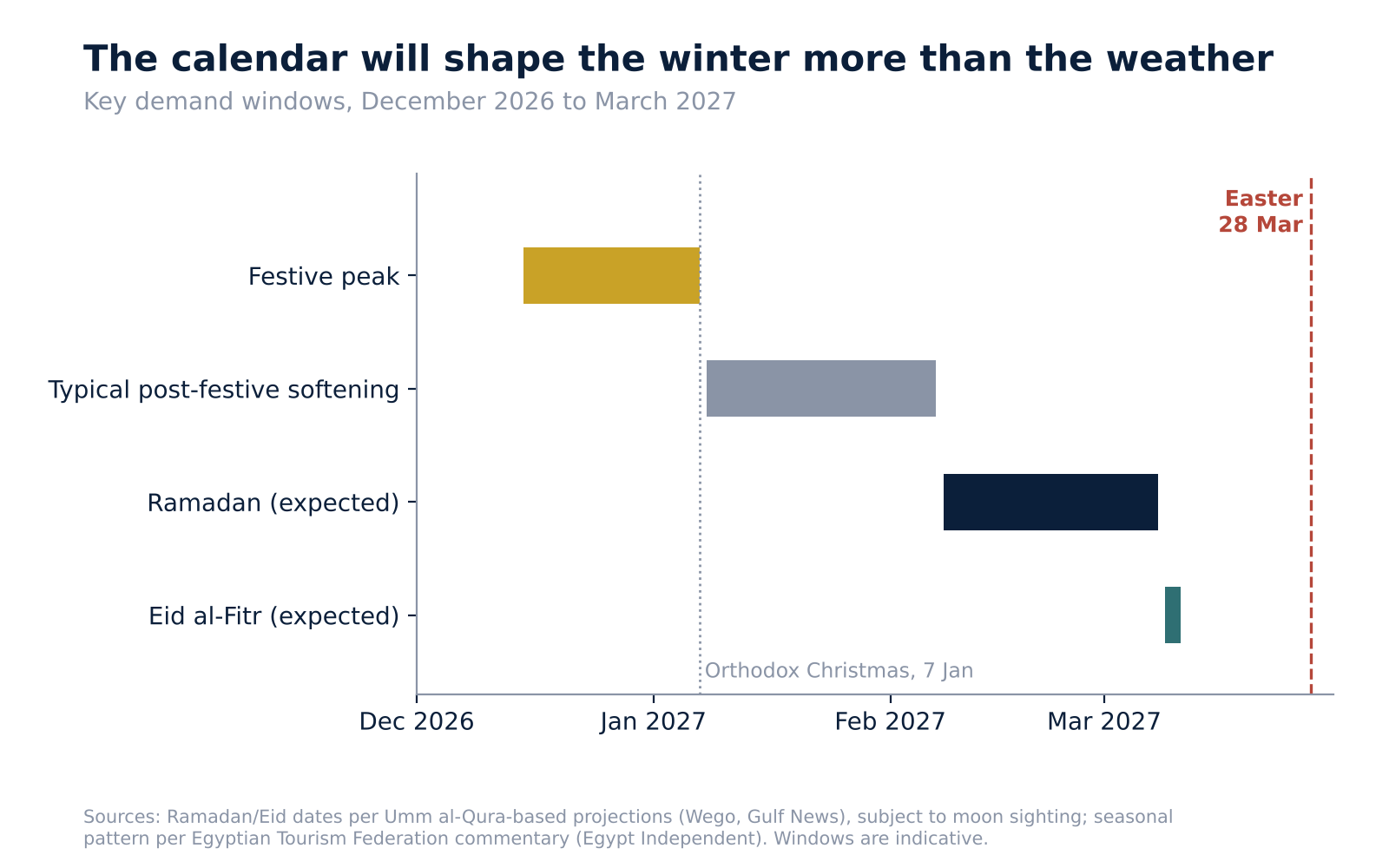
The calendar is unusually demanding. The festive peak is followed by the traditional January lull, and Ramadan is expected to begin around 8 February, so February will largely be a Ramadan month.
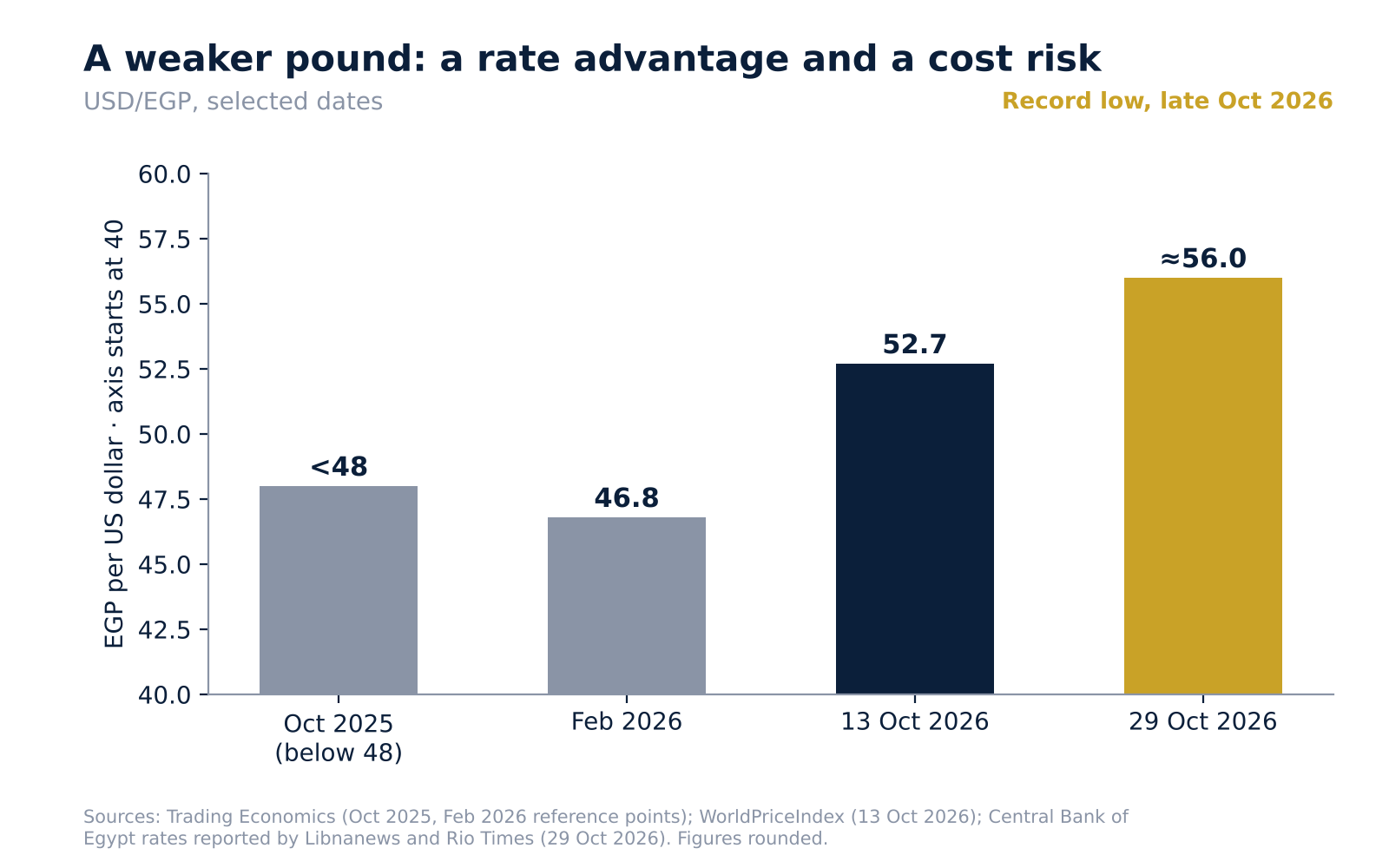
The pound is the biggest planning variable. It touched a record low near 56 per US dollar in late October, from about 47 in February, while the central bank raised rates to 20%.
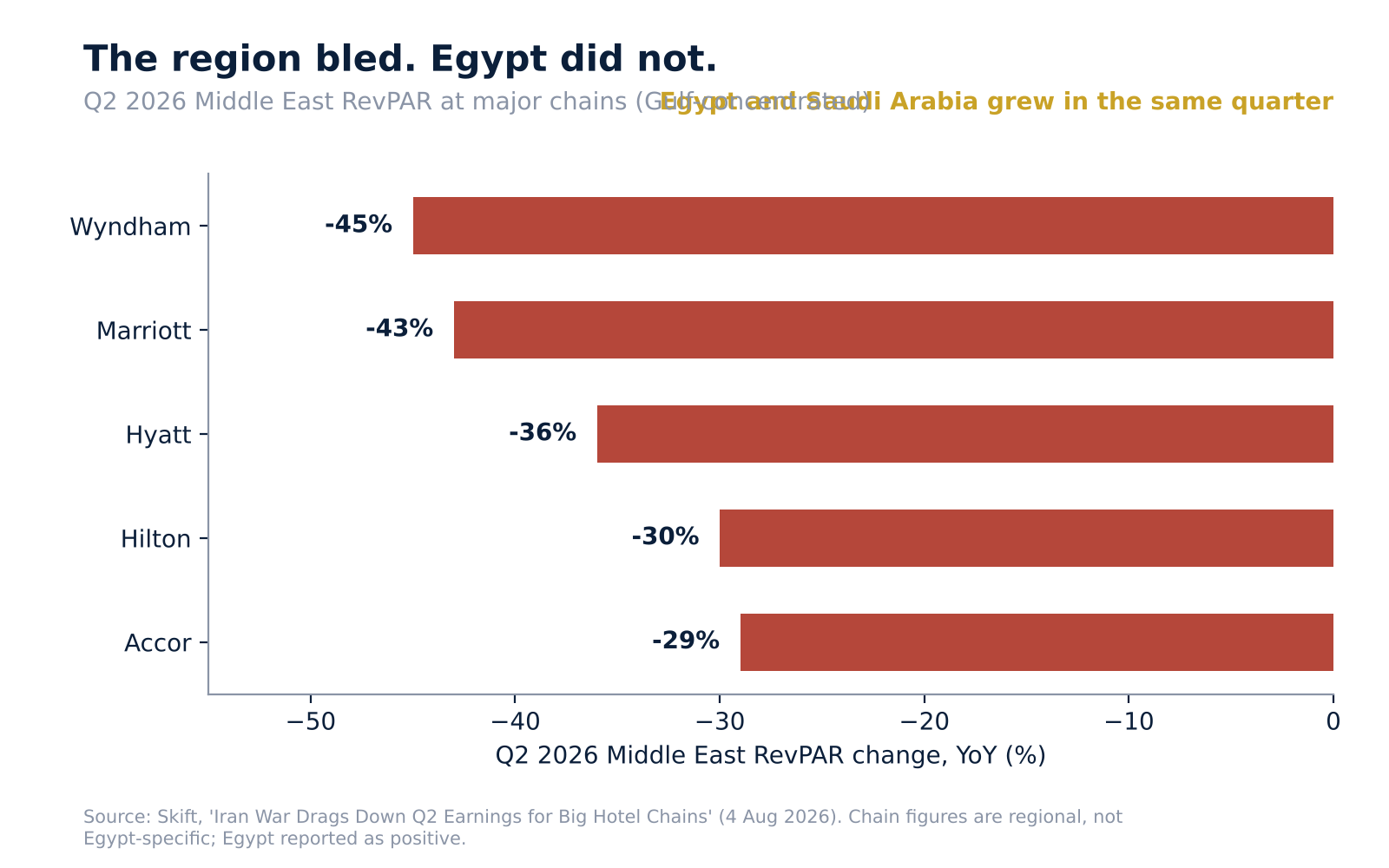
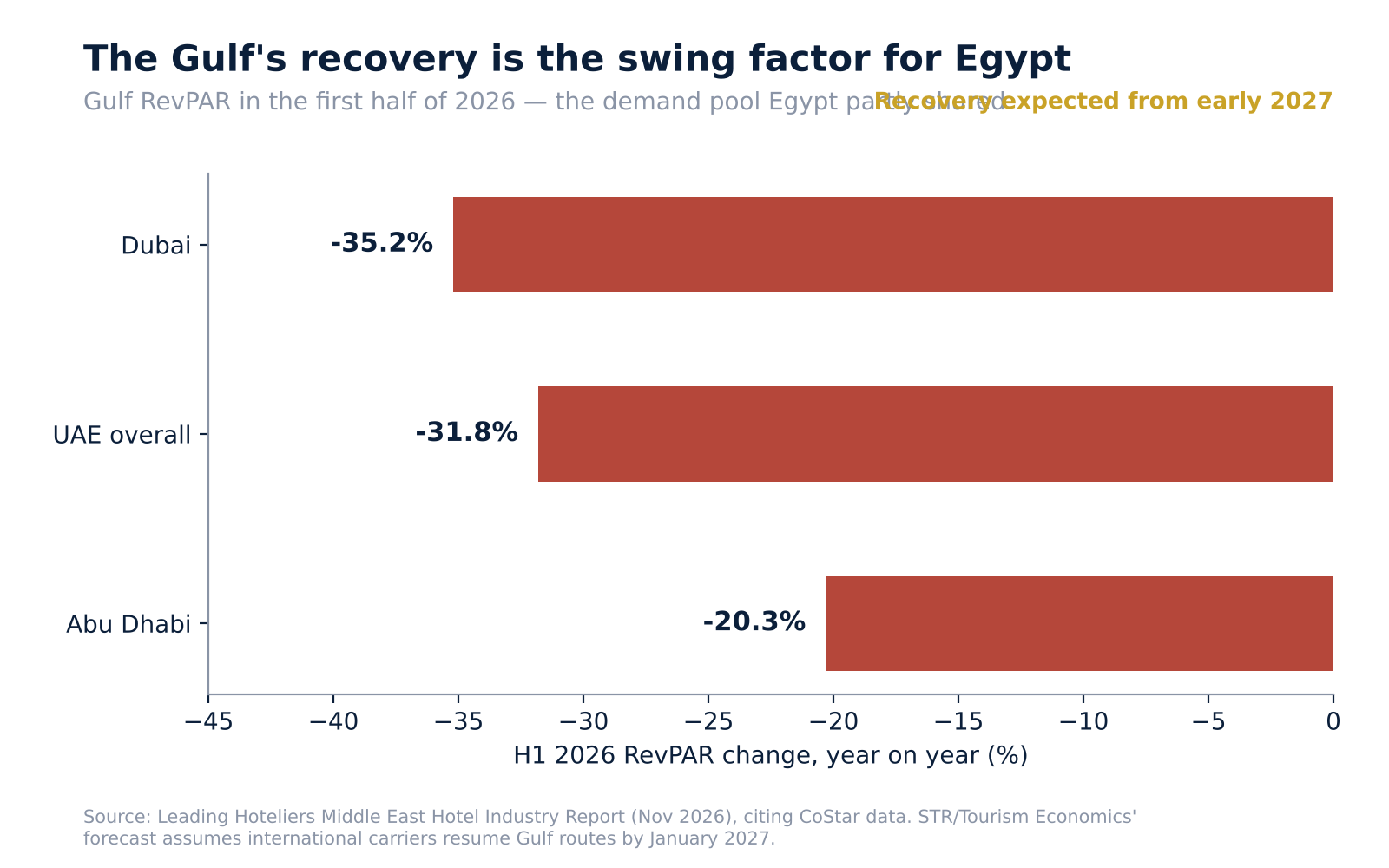
Geopolitics remains the swing factor. Gulf aviation is recovering but unevenly. How fast it normalises will influence whether Egypt keeps the diverted demand it enjoyed in 2026.
Forecast ranges, not points. The winning approach this season is a base, upside and downside case with clear trigger points for re-forecasting.
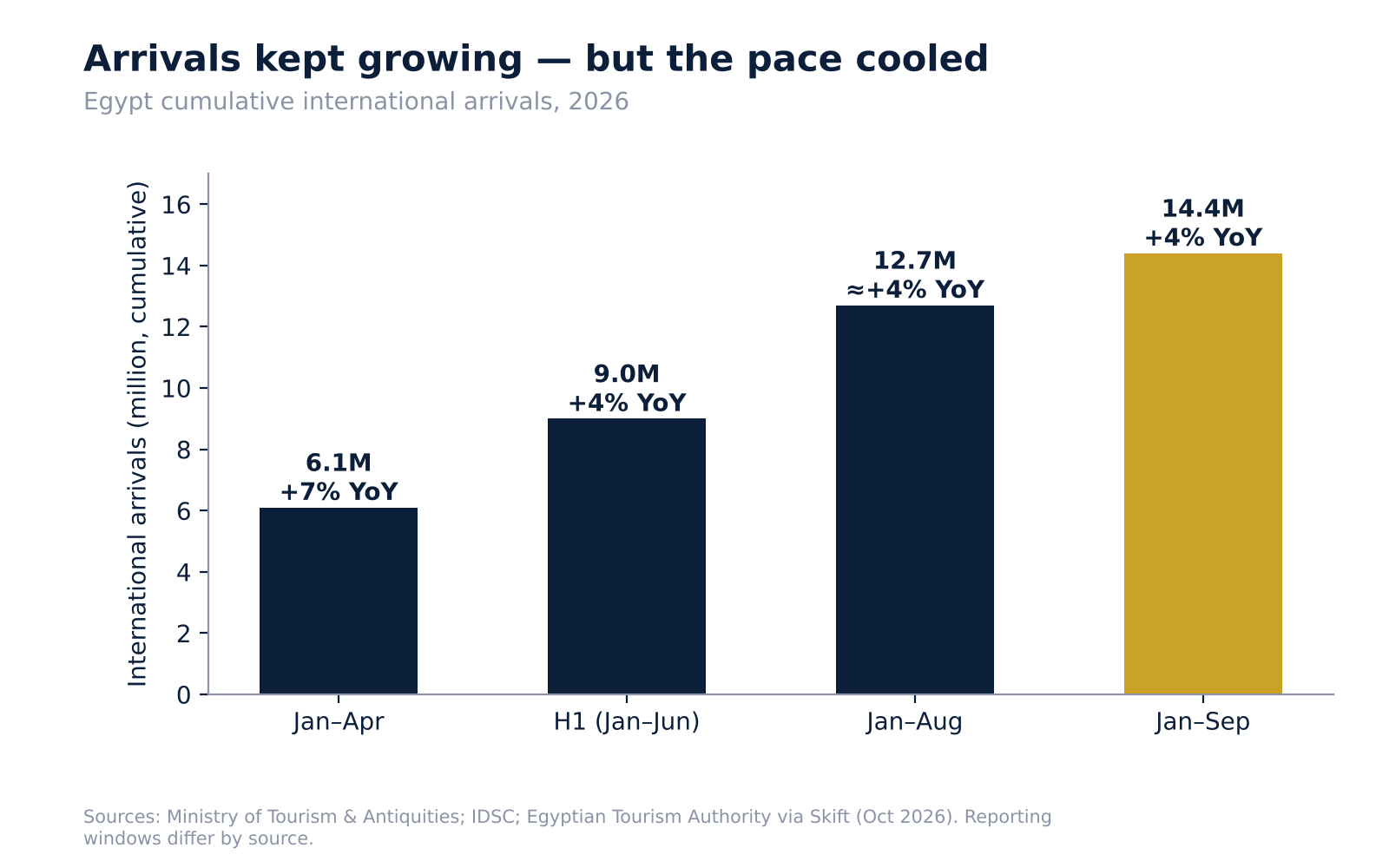
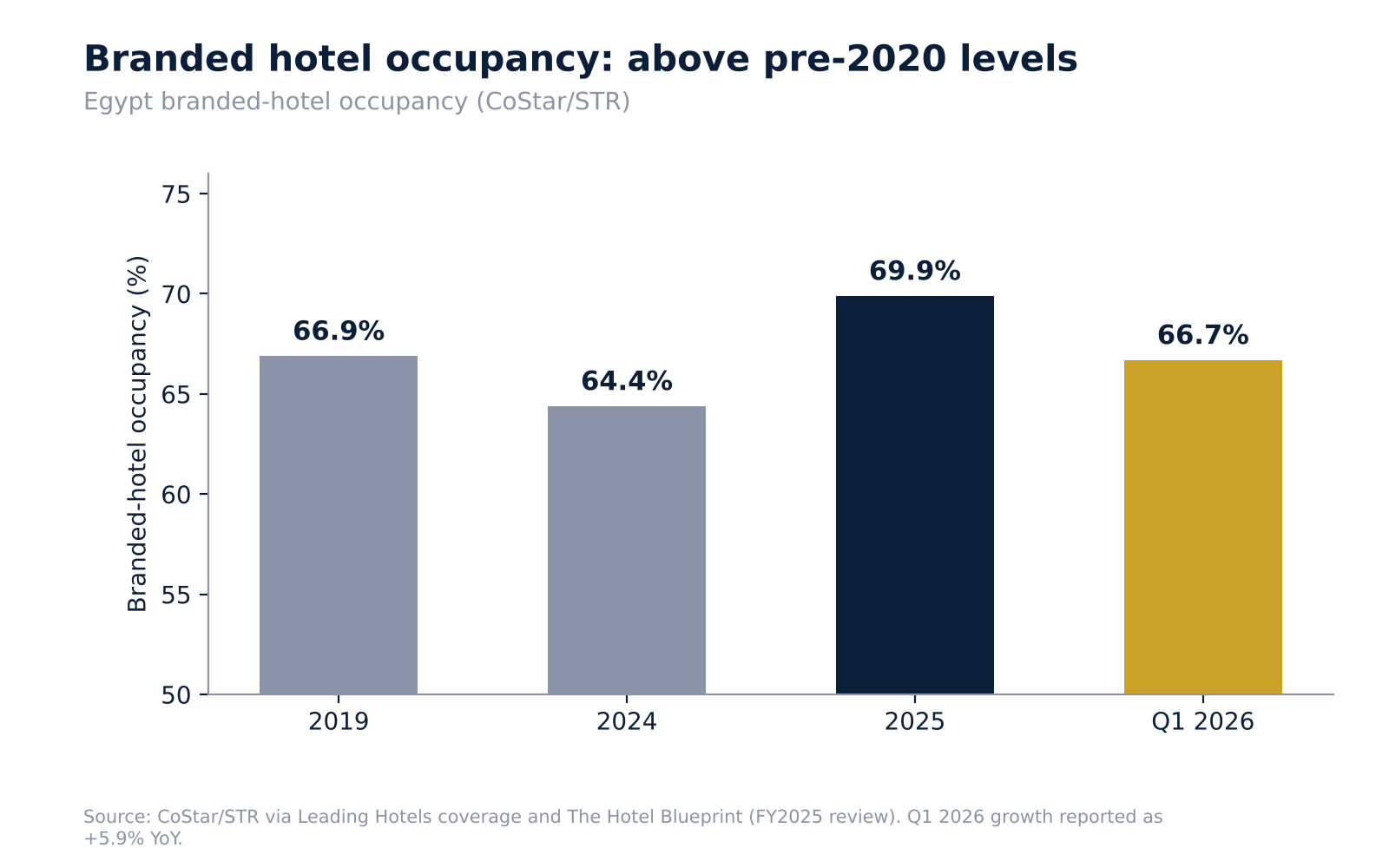
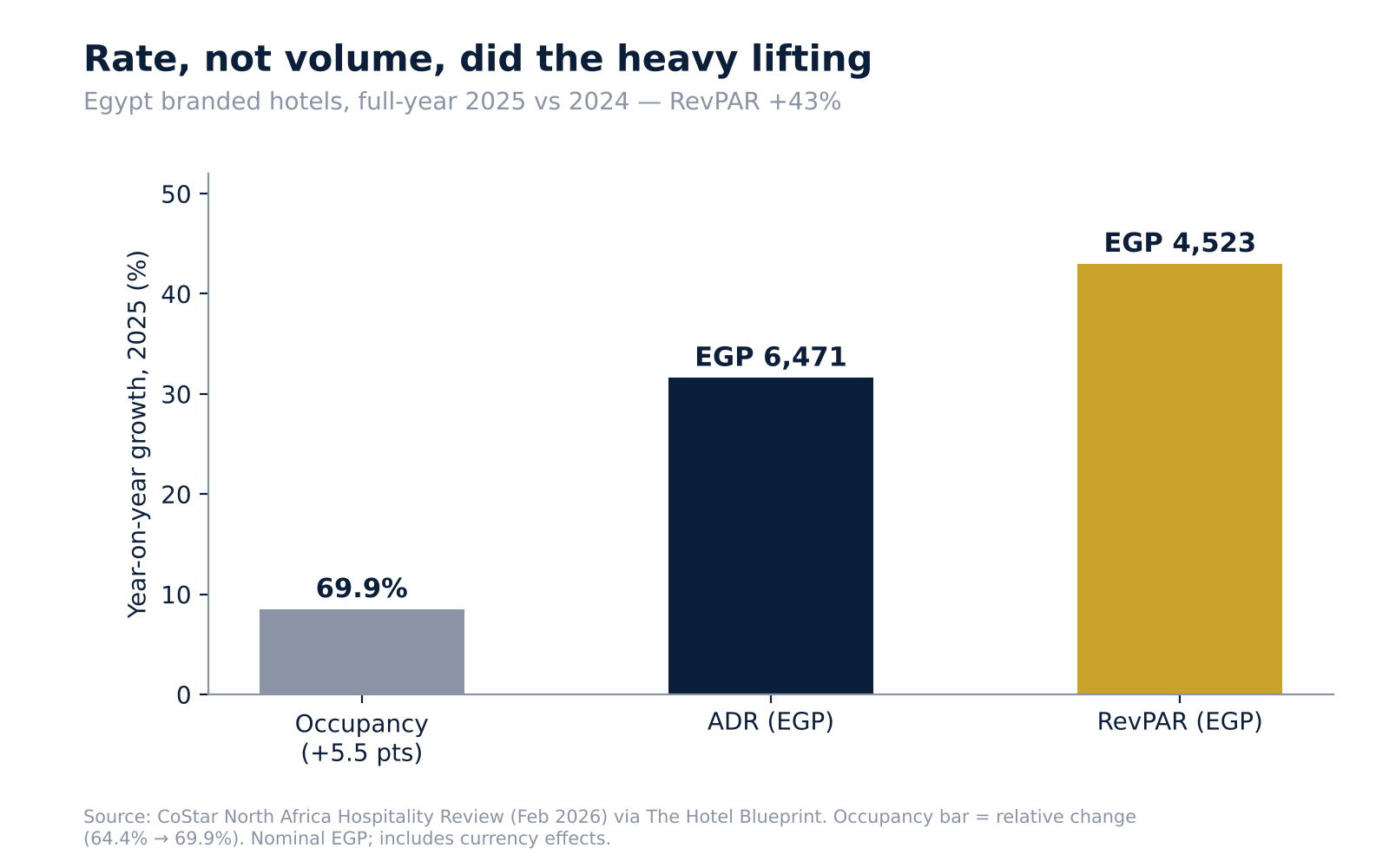
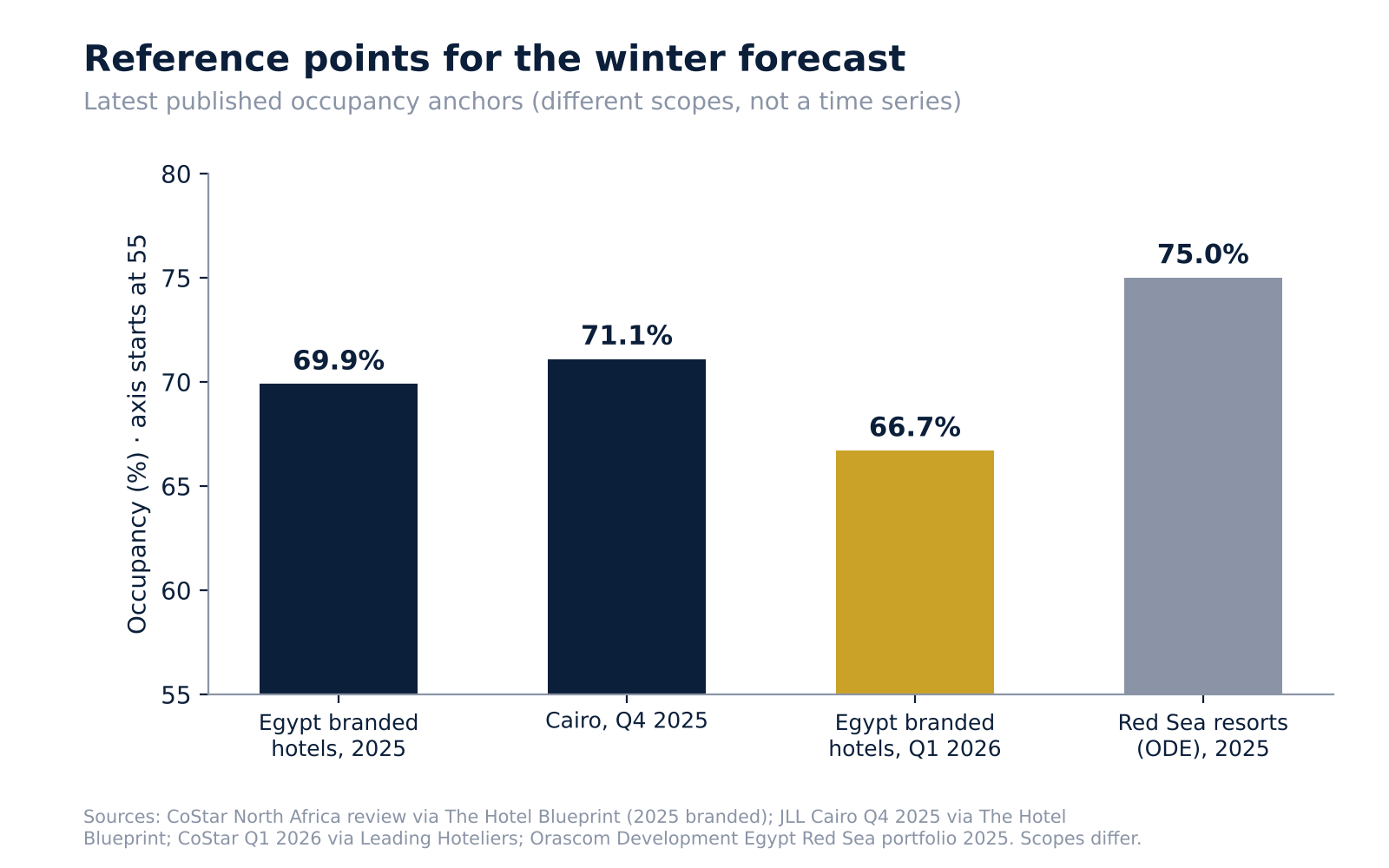
The baseline is strong. CoStar's North Africa review put branded-hotel occupancy at 69.9% for 2025, with RevPAR up 43% year on year. Cairo closed the winter 2025 window at around 71% occupancy, according to JLL, and Q1 2026 branded occupancy was reported at 66.7%. Through the summer, Hurghada reported near-full hotels, and cumulative arrivals reached about 14.4 million in the first nine months of 2026, roughly 4% above last year.
Two cautions apply when you use these numbers as a launch pad. First, they are nominal Egyptian-pound figures and carry currency and inflation effects. Second, they mix scopes, from national branded hotels to a single operator's Red Sea portfolio, so they are reference points rather than a clean time series.
December is shaped by two forces: the European winter-sun season and the festive window. Industry commentary has traditionally placed Egypt's peak in the second half of December and the first week of January. Evidence for this winter points the same way. Beyond TUI's ranking, Condor, Wizz Air and Air Cairo have added or extended Red Sea and Cairo routes for the season, and Jet2 is preparing its return to the Egyptian market, with 18 weekly flights planned from seven British airports to Hurghada and Sharm El Sheikh from 2027.
The working assumption for planners is a strong festive period at the Red Sea resorts, with Cairo and Luxor supported by cultural tourism and the Grand Egyptian Museum. The risk is not demand but price discipline: a record pound weakness makes foreign-currency rates look cheap, and the temptation to discount early can leave money on the table in the peak weeks.
January is typically softer once the festive window closes. Egyptian Tourism Federation commentary in past seasons describes occupancy easing through January and February before recovering from March. That pattern is the reasonable base case again, with resort markets more exposed than Cairo.
This is also the month where the Gulf story could start to bite. STR and Tourism Economics have deliberately not upgraded their Q4 2026 Middle East forecasts, but have raised expectations from Q1 2027 on the assumption that international carriers resume Gulf routes by January. If that happens, some leisure travellers who diverted to Egypt in 2026 may return to the Gulf. If it slips, Egypt keeps more of that demand. Either way, January bookings made in November and December are your best early signal.
February carries the new variable. Ramadan is expected to start on or around 8 February 2027 and run to about 8 March, with Eid al-Fitr on 9 or 10 March, subject to moon sighting. Western Easter follows on 28 March.
STR's regional commentary offers a useful precedent from the last time Ramadan overlapped a high season. Markets with a larger international or leisure base held occupancy better, because non-Muslim travellers still travel. For Egypt, that means Red Sea resorts selling to European guests are relatively insulated, while Cairo, Alexandria and the business, events and domestic segments should expect a different rhythm: lower daytime food and beverage, stronger evening iftar and suhoor activity, and fewer corporate gatherings. Arab-market demand will be softer until Eid.
The Egyptian pound crossed 56 per US dollar at the central bank in late October, a record low, and the central bank raised its key rates by one percentage point to 20% on 29 October. Reported inflation has eased to around 12% to 14%, depending on the measure.
For hoteliers this cuts both ways. A weaker pound makes Egypt cheaper for foreign guests, supporting volume and enabling rate growth in hard currency. But it raises the local cost of imported food, equipment, spare parts and energy, and it increases the burden of any foreign-currency debt. A hotel that raises its pound rates by 10% while the pound falls 15% is cutting its dollar price while its costs rise. That mismatch, not occupancy, is where winter margin will be won or lost.
Separate volume, rate and mix. Forecast occupancy, ADR and source-market mix independently, then combine. A flat occupancy line can hide a shift toward lower-yield tour-operator business.
Forecast in two currencies. Build the budget in Egyptian pounds and in your main contract currency, and show both. Year-on-year growth in pounds will look spectacular and may mean little in euros or dollars.
Use pace, not just history. Compare on-the-books reservations and pickup against the same date last year, and track cancellations. After a volatile year, last winter is an imperfect guide.
Model the calendar explicitly. Treat the festive window, the January softening, Ramadan and Eid as separate periods with their own demand assumptions, rather than as monthly averages.
Stress the Gulf assumption. Test what happens to your pace if diverted demand returns to the Gulf, and what happens if it re-escalates. The early November strikes reported near Iran's Qeshm Island are a reminder that the situation is not resolved.
Watch the cost side. Energy, food, labour and replacement costs are moving with the pound. STR has warned that hotel operating expenses are rising faster than general inflation in major markets, so protect flow-through, not just revenue.
Benchmark against your competitive set. Where you have STR participation, look at your index against your set. A strong month in a strong market may be the market, not you.
Respect data quality. Public figures for Egypt are inconsistent between sources and reporting windows. Treat headline growth claims with care, and rely on your own booking data first.
Protect rate integrity in the peak weeks. Price the festive window on demand, not on competitors' discounts, and use length-of-stay and advance-purchase fences instead of blanket reductions.
Price in hard currency where contracts allow. Where you contract in pounds, shorten rate validity and add review clauses so a further move in the exchange rate does not erode your yield.
Plan February deliberately. Build Ramadan offers early: iftar and suhoor packages, staycations for local and Gulf families, and Eid bookings. Adjust staffing and outlet hours to the new rhythm rather than discovering it in the first week.
Lock in costs early. Buy long-lead and imported items before further currency moves where cash allows, and widen local sourcing for food and supplies.
Diversify source markets. Germany, the United Kingdom, Poland, Italy, the Nordics and Russia behave differently. A balanced mix reduces the damage from any single airline, advisory or currency shock.
Build a forecast rhythm. Re-forecast weekly on pace and monthly on scenarios, with agreed triggers: for example the confirmation of Gulf carrier schedules in January, the official Ramadan start date, and any change in travel advisories.
Keep a liquidity buffer. With rates at 20% and the pound volatile, avoid committing discretionary capital until the February picture is clear.
Base case: steady resort strength, a softer Cairo February. European demand holds, the festive peak delivers, January eases as usual, and Ramadan reshapes the second half of February. Gulf routes return gradually.
Upside: calm returns early. Gulf carriers restore capacity by January and confidence recovers. Egypt benefits from better long-haul connectivity through Gulf hubs and from the new UK and European flights, while some diverted demand leaves. Net effect: healthy, but with more competition for the same guests.
Downside: renewed escalation or a currency shock. Airfares and fuel costs rise, cancellations increase and a further pound move squeezes costs. Resort markets with tour-operator dependence are most exposed to schedule cuts.
These are planning frames, not predictions. Each hotel should attach its own numbers to them using its own pace data.
The winter of 2026/27 is a test of discipline rather than demand. Egypt enters it with strong momentum, new airline capacity and a record pound weakness that makes the destination attractive. The hotels that benefit most will be those that resist the urge to chase volume, price by period rather than by month, manage costs against the currency, and treat the Gulf's recovery as a variable to monitor rather than a headline to react to.
We will return to this article once December, January and February data are published, and compare what the market delivered against these frames.
Travel And Tour World, "Egypt's UK Tourist Arrivals Surge 9.4% as New Flights and Winter Holidays Boost Travel Growth" (Nov 2026): travelandtourworld.com
Wikipedia, "Air Cairo" and "Hurghada International Airport" (winter 2026/27 route additions): wikipedia.org
Libnanews, "Egyptian pound: Central bank raises its rates" (4 Nov 2026): en.libnanews.com
Rio Times, "Egypt Raises Interest Rates to 20%" and "Egypt Inflation Slows to 12.0% in October" (Oct–Nov 2026): riotimesonline.com
Trading Economics, Egypt inflation rate and interest rate pages: tradingeconomics.com
WorldPriceIndex, Egypt exchange rates (13 Oct 2026): worldpriceindex.org
Hotel-Online / STR and Tourism Economics, "Europe Hotel Growth Slows as ADR Carries RevPAR Gains; Asia Pacific and Middle East Show Resilience" (Oct 2026): hotel-online.com
Leading Hoteliers, "The Middle East Hotel Industry Report: The Bifurcated Recovery, the Pipeline Paradox, and the Profitability Imperative" (Nov 2026): leading-hoteliers.com
AGBI, "Winter schedules reveal the resilience of Gulf aviation" (3 Nov 2026): agbi.com
Aviation Week, "Arab Airlines Forecast Fast Bounceback If Peace Returns To Middle East" (3 Nov 2026): aviationweek.com
Gulf News, Dubai Standard and The Traveler, Gulf flight and security updates (Nov 2026): gulfnews.com, dubaistandard.com, thetraveler.org
Wego and Gulf News, "When is Ramadan 2027?": blog.wego.com, gulfnews.com
CoStar / STR, "Middle East & Africa hotel performance update" (Ramadan and high-season overlap): costar.com
Egypt Independent, "Egypt's hotels increase room rates by 7-15 percent" (seasonal pattern commentary): egyptindependent.com
The Hotel Blueprint, "Hotel Performance Review: Egypt, Full Year 2025" (CoStar and JLL data): thehotelblueprint.com
Skift, "Egypt Has the Visitors. Now It Wants Them to Stay Longer and Spend More" (29 Oct 2026): skift.com


Founder & Host

By Tourism Club | The Story Behind the Industry
Egypt’s hospitality sector entered 2026 with positive momentum, supported by growing international demand, continued hotel investment and the expansion of the country’s tourism infrastructure. However, the real question for hotel owners, General Managers and commercial leaders is not simply whether more tourists are visiting Egypt. The more important question is whether this demand is translating into stronger hotel performance, higher revenue, improved market share and sustainable profitability.
The 2025 baseline: A stronger starting point
According to CoStar’s reported data for Egypt’s branded hotel market, average Occupancy reached 69.9% in 2025, compared with 64.4% in 2024 and 66.9% in 2019. Average Daily Rate (ADR) reached EGP 6,471, representing an increase of 31.6%, while Revenue per Available Room (RevPAR) increased by 43% to EGP 4,523. These figures indicate that the market achieved more than an improvement in room demand: pricing performance also contributed significantly to revenue growth. However, these figures represent a branded hotel sample, not the entire Egyptian hotel inventory.

Q1 2026: Positive demand momentum
The first quarter continued to demonstrate resilience. Egypt’s branded hotel occupancy reached 66.7%, an increase of 5.9% year-on-year, according to CoStar. Separately, reported tourism data indicated that international arrivals increased by 16% during Q1. These indicators suggest that Egypt remained an attractive destination despite regional uncertainty. Nevertheless, increased arrivals do not automatically translate into equivalent growth in hotel revenue. The conversion depends on destination mix, length of stay, visitor spending, hotel category, distribution channels and the ability of hotels to capture demand at the right rate.

Q2 2026: The importance of destination-level analysis
The second quarter highlighted why national tourism figures should not be interpreted as a complete picture of hotel performance. Cairo market coverage reported Occupancy of 62.4% through June, down 3.3 percentage points year-on-year. ADR reached approximately US$154, increasing by 0.6%, while RevPAR declined by 4.6% to around US$96.10. These are Cairo-specific market indicators reported in secondary coverage referencing JLL, not national hotel statistics. They illustrate an important commercial challenge: relatively stable pricing does not necessarily protect RevPAR when Occupancy declines.
Q3 2026: Demand resilience, but the data needs careful interpretation
For January to August 2026, official figures reported approximately 12.7 million tourist arrivals, compared with 12.2 million during the same period in the previous year, an increase of around 4.1%. Tourism revenues reached approximately US$12 billion, compared with US$11.8 billion, an increase of around 1.7%. The difference between the growth rates deserves attention. Arrivals increased faster than tourism revenues, suggesting that growth in visitor numbers did not translate into an equivalent increase in total tourism receipts. This is a national tourism indicator, however, and should not be treated as a direct measure of hotel ADR, RevPAR or profitability. It also covers January to August, not the complete third quarter. A complete national Q3 STR dataset has not been established in the public sources reviewed for this article.

Reading hotel performance through STR
For hotel management, three indicators remain central: Occupancy measures the percentage of available rooms sold; ADR measures the average rate achieved for rooms sold; and RevPAR measures room revenue generated per available room. RevPAR is particularly important because it combines Occupancy and ADR. A hotel can increase Occupancy by reducing rates, but this does not necessarily improve RevPAR or profitability. Equally, a hotel can increase ADR while losing market share if its pricing strategy is not aligned with demand and its competitive position.
From performance measurement to competitive positioning
STR benchmarking becomes more valuable when a hotel compares its performance with an appropriate Competitive Set. The Market Penetration Index (MPI) measures Occupancy performance against the competitive set. The Average Rate Index (ARI) measures ADR performance. The Revenue Generation Index (RGI) measures RevPAR performance. An index above 100 indicates performance above the competitive set average, while an index below 100 indicates underperformance. These indicators help management identify whether a hotel is gaining or losing market share, achieving a rate premium, and converting its market position into room revenue. However, the indices must be interpreted together. A high MPI combined with a low ARI may indicate that the hotel is buying Occupancy through lower rates. A high ARI combined with a low MPI may indicate that pricing is limiting demand. A strong RGI indicates that the hotel is outperforming its competitive set in RevPAR, but it does not by itself confirm stronger net profit.

The supply pipeline: Opportunity and competitive pressure
Egypt’s hotel development pipeline is expanding. Government-reported figures indicate a pipeline of approximately 185 hotels and 46,000 rooms in 2026, compared with 143 hotels and 33,900 rooms in 2025, and 109 hotels and 26,200 rooms in 2024. This expansion reflects investor confidence in the destination, but it also raises important strategic questions. Where will this new supply be located? Which segments will it target? Will demand grow at the same pace? And how will existing hotels defend their market share? More rooms create capacity, but capacity alone does not guarantee demand, rate growth or investment returns.
One country, different hotel markets
Egypt should not be treated as one uniform hotel market. Cairo, the Red Sea, the Mediterranean coast, Luxor, Aswan and other destinations have different demand generators, seasonality patterns, customer segments and distribution structures. Cairo’s performance may be influenced by corporate travel, government business, events and MICE activity. Red Sea destinations depend more heavily on leisure demand, international tour operators, airline capacity and seasonal travel patterns. Upper Egypt has a different demand profile, with cultural tourism and Nile cruise activity playing important roles. Consequently, a national Occupancy average cannot replace destination-level analysis. Management decisions should be based on the performance of the specific destination, hotel segment and competitive set.
Revenue growth is not the same as profit growth
One of the most important management considerations is the difference between revenue performance and profitability. Higher ADR and RevPAR are positive indicators, but operating costs may also increase through payroll, energy, food and beverage, maintenance, distribution commissions and other expenses. The final result depends on how effectively the hotel converts revenue into operating profit. This is where Revenue Management must work closely with Sales, Marketing, Finance and Operations. The objective should not be to maximise Occupancy at any cost or increase ADR without considering demand elasticity. It should be to optimise total revenue, manage distribution costs, protect rate integrity and improve profitability.
What should hotel leaders focus on?
For General Managers, Directors of Sales and Marketing, and Revenue Managers, the next phase requires a more disciplined approach to commercial decision-making. First, review STR performance regularly and understand the reasons behind changes in MPI, ARI and RGI. Second, assess the quality of business by segment, source market, channel and booking window rather than focusing only on room nights. Third, strengthen Direct Business while managing the cost and contribution of OTAs and tour operators. Fourth, align pricing decisions with demand forecasts, competitor behaviour and the hotel's positioning. Fifth, connect commercial performance with financial results through indicators such as GOP, GOPPAR and departmental profitability. Finally, build destination-specific strategies instead of relying on national averages.
The strategic question for the coming quarters
The key question is no longer simply how many tourists will visit Egypt. It is how effectively the hospitality industry can convert tourism demand into sustainable economic value. Will the growth in arrivals be accompanied by stronger visitor spending? Will new hotel supply be absorbed without putting pressure on Occupancy and ADR? Can hotels protect their competitive position while controlling operating costs? And will commercial leaders use STR data as a reporting tool or as a foundation for better strategic decisions?
Tourism Club perspective
Egypt’s hospitality opportunity is significant, but growth alone is not a strategy. The next stage of industry development will depend on the quality of investment, the strength of destination management, the competitiveness of hotel products and the ability of leadership teams to make evidence-based decisions. For hotel owners and management teams, the challenge is to move beyond measuring performance to understanding what drives it, why it changes and what action should follow. Because in hospitality, the real competitive advantage is not simply having more rooms or welcoming more guests. It is knowing how to turn demand into value.
Sources and data note: CoStar; JLL, Cairo Hospitality Market Dynamics Q2 2026; Egyptian State Information Service / IDSC; UN Tourism. The figures in this article refer to different datasets, geographic scopes and reporting periods. Branded hotel STR figures, Cairo market indicators and national tourism statistics are not interchangeable. The January–August national tourism figures do not represent a complete Q3 result. No national Q1–Q3 MPI, ARI or RGI values are presented because a complete, verified dataset was not available for this article.

For decades, travel companies have competed to influence a decision that begins long before a guest arrives at a hotel: where to go, which airline to fly, which property to book and how much to spend. Now, a new competitor is beginning to enter that decision-making process, and it does not look like a traditional travel agency or online travel platform.
On September 8, 2026, Meta launched Muse, a personal AI agent designed to do more than answer questions. It can work on a user's behalf, browse websites, complete forms, negotiate, book travel and make purchases, subject to the permissions and approvals required for particular actions. Accessible through its own application and WhatsApp, Muse is powered by Meta's Muse Spark model and was initially rolled out in the United States.
What makes this development important for hospitality is not simply that AI can recommend a hotel. Travel websites and chatbots have been doing that for years. The emerging difference is that an AI agent can potentially carry the process further, moving from understanding a traveller's preferences to researching options, making comparisons and completing a booking.
For the hospitality industry, that raises a commercially significant question: if the traveller delegates much of the decision to an AI agent, who influences the final choice—the hotel, the online travel agency, the airline or the AI system deciding which options to present?
The answer could reshape how travel businesses compete for demand.
The traditional digital travel journey requires the customer to move between websites, compare prices, read reviews, check cancellation policies and complete several booking steps. Each interaction offers a travel company an opportunity to influence the decision, promote its brand or encourage a direct booking.
An agent such as Muse changes the potential distribution of that work. Instead of manually searching across multiple websites, a traveller could ask the agent to plan a trip within a specified budget, compare flights and accommodation, evaluate alternatives and handle the booking process. Meta says Muse can work through a dedicated cloud-based virtual machine with its own browser, continue working after the user closes the application and request approval when sensitive actions, such as sending an email or making a purchase, require it.
This does not mean that AI agents have replaced online travel agencies or that every booking can already be completed autonomously. The more important change is that the interface through which a traveller makes decisions may be shifting. If an agent becomes the customer's primary point of contact, the hotel website may remain essential for delivering inventory and service information, but the traveller may no longer visit it directly.
That creates a new competition for visibility. Hotels have spent years improving website conversion, investing in search engine optimisation, buying digital advertising and building loyalty programmes. In an agent-led environment, those investments may still matter, but hotels may also need to ensure that their rates, availability, room descriptions, policies and other relevant information can be understood and acted upon by AI systems.
The question for hotel leaders is therefore no longer only how to attract a traveller to the booking engine. It is whether the hotel can become a preferred and reliable choice when the traveller delegates that decision to an agent.
The early implementation of Muse illustrates an important limitation. Meta's travel-booking capabilities do not rely on one uniform system. According to travel-industry publication Skift, flight searches can use a direct integration with Duffel, a travel technology company providing access to live airline inventory, while hotel discovery initially relies more heavily on browser-based searches across consumer travel websites.
Why does this distinction matter? Because the quality of an AI agent's decision depends partly on the information it can access and the transactions it can complete. A direct connection to live inventory can provide structured availability and booking options, while browsing websites may require the agent to interpret information displayed across different formats and navigate each provider's own rules.
Hotels face a particular challenge because room rates are not the only variables in a booking decision. The final choice may depend on cancellation terms, breakfast, room configuration, location, loyalty benefits, taxes, payment requirements and availability for specific dates. If an agent cannot reliably compare those details, it may recommend a property that looks attractive on headline price but offers less value once the full conditions are considered.
This is where integrations with hotel technology could become important. On October 20, 2026, hospitality technology provider Cloudbeds announced an integration with Muse intended to make participating hotels' live rates and availability discoverable through the agent, with bookings routed through participating properties' direct booking engines. The rollout is scheduled to begin in the United States in the first quarter of 2027.
The announcement points to a potential direction for hotel distribution: instead of depending entirely on AI agents to browse consumer-facing websites, hotels could provide structured access to live inventory and policies through connected technology platforms. For independent hotels and smaller groups, this could become particularly relevant if direct integration would otherwise require significant technical investment.
However, the Cloudbeds announcement concerns a planned US rollout; it does not establish that the same booking capability is already available to Egyptian hotels. For MENA operators, the immediate task is to understand the emerging model and determine whether their own booking infrastructure will be compatible as agent-led travel expands.
Hotels have spent years trying to reduce their dependence on third-party distribution and increase direct bookings, where they can retain greater control over the guest relationship and avoid some third-party acquisition costs. AI agents introduce a new variable into that strategy.
If a hotel can make its live rates and availability accessible to an AI agent while preserving its own booking engine, it may have an opportunity to win direct business without requiring the traveller to navigate the hotel's website personally. But if the agent searches primarily through online travel agencies or other intermediaries, the hotel may still depend on those channels to be discovered and booked.
The decisive factor will be how the agent searches, compares and selects its options. Does it prioritise price, location, guest reviews, cancellation flexibility, loyalty benefits or a combination of criteria? Can a hotel explain its distinctive value in a format the agent can interpret? And can a property ensure that its direct offer is competitive without relying on discounts that weaken rate integrity?
These questions matter because AI may change not only where a booking occurs but also who influences the decision before the booking begins. The intermediary that controls the customer interaction could gain leverage over which properties are considered, which options are presented and which booking routes are used. Accenture's September 2026 analysis of AI agents in travel similarly argues that travel brands will need to be understandable, trustworthy and actionable for AI systems, not merely visible to human customers.
For hotels, the implication is that direct distribution strategy will increasingly need to consider both the human guest and the systems acting on that guest's behalf.
The transition is unlikely to be frictionless. On September 21, Amazon blocked Muse from shopping on its retail platform, saying the agent's access was unauthorised and that third-party applications should operate transparently and respect a service provider's decision about whether to participate. Meta's launch materials, meanwhile, describe safeguards intended to protect user credentials and require approval for sensitive actions.
Although this dispute concerned retail rather than travel, it illustrates a challenge that hotels, airlines and online travel platforms will also need to consider: an AI agent's technical ability to browse a website does not automatically establish permission to use it for automated transactions. Access rules, privacy, authentication, platform terms and the reliability of bookings will all influence how agent-led commerce develops.
Travel suppliers will therefore need to distinguish between making their information available, authorising an agent to transact and allowing an external system to use their infrastructure at scale. AI agents could generate additional bookings, but they could also generate extensive searches, incomplete transactions or demands on websites and booking engines that do not convert into revenue. The commercial relationship between the agent and the supplier will matter as much as the technology itself.
For Egypt and the wider Middle East, the development should be treated as an emerging distribution issue rather than an immediate reason to replace existing sales and marketing systems. The available evidence does not establish how much travel demand in Egypt will soon be booked through Muse or similar agents, and Muse's initial rollout was in the United States. Nevertheless, regional hotels, destination organisations and travel companies can begin reviewing the readiness of their digital infrastructure.
Hotels should first ensure that their core product information is accurate and consistent across their websites, booking engines and distribution partners. Room descriptions, live rates, taxes, cancellation policies, meal plans, availability and location information should be easy for digital systems to interpret. Revenue managers and commercial directors should also monitor how agent-driven searches may change price comparison, booking lead times and direct-versus-indirect channel production.
Hotel technology providers and distribution partners have a role to play as well. The expansion of structured connections between AI agents and booking systems could determine which properties are discoverable through agent-led planning and whether a reservation can be completed without sending the customer through multiple disconnected interfaces. In markets where many independent properties operate with limited digital resources, accessible integration solutions could matter more than adopting a sophisticated AI tool in isolation.
Destination marketing organisations will need to think about the same issue at a larger scale. If travellers increasingly ask AI agents to recommend a destination based on budget, travel dates, climate, interests and practical access, then accurate, current and machine-readable information about attractions, transport, hotels and experiences becomes part of destination competitiveness. A destination needs to be not only attractive to people but also reliably represented in the information systems helping those people make decisions.
Muse is an early example of a broader change in digital commerce: users may increasingly delegate research, comparison and transactions to agents rather than complete every step themselves. That shift is not yet universal, and its consequences for hospitality will depend on adoption, supplier integrations, consumer trust and the commercial rules governing access to travel inventory.
But the direction is important. Hotels and destinations that treat AI only as a content-generation tool may miss its potential effect on distribution. The bigger strategic question is how their products will be discovered, evaluated and purchased when software begins to make more of the decisions that travellers once made themselves.
Meta's Muse launch brings an important question into sharper focus for hospitality leaders: when the customer delegates the journey to AI, does the hotel still control how it competes for that customer?
The answer will depend on whether hotels and tourism businesses can make their products visible, their information reliable and their booking systems accessible to emerging AI agents, while protecting pricing discipline, data security and the direct guest relationship.
For Egypt and MENA, the immediate priority is not to assume that agentic travel will replace existing distribution channels overnight. It is to prepare for a market in which the traditional traveller, the online travel agency and the AI agent may all play different roles in the same booking journey.
The hotels that adapt will not necessarily be those using the most AI. They will be the ones that understand where the booking decision is being made, how their product is being evaluated and how to remain commercially competitive when the first customer to compare their rooms may be a machine acting for a human.
Meta — Introducing Muse: The World’s First Personal AI Agent Built for Everyone
PhocusWire — Meta launches AI agent with travel booking capabilities
Skift — Meta Says Its Muse Agent Books Travel. Here’s What That Means
Hospitality Net — Cloudbeds announces integration with Meta’s Muse

Japan is a market Egypt has never really had to convince of the value of ancient Egyptian civilization. The interest has been there for years. The harder commercial question is what Egypt does with that interest now.
During his visit to Tokyo for Tourism Expo Japan 2026, Tourism and Antiquities Minister Sherif Fathy held meetings with Japanese tour operators, tourism companies and major media organisations to discuss increasing tourism to Egypt. The discussions focused on developing new programmes for Japanese travellers, organising familiarisation trips for Japanese tourism companies and increasing direct flights between Egypt and Japan.
The Ministry is also deepening its institutional relationship with the Japan Association of Travel Agents (JATA). Fathy met JATA’s leadership to discuss increasing Japanese arrivals and explored the possibility of organising incentive trips to Egypt. He also invited the association to hold its annual meeting in Egypt, an invitation that was welcomed by the Japanese side.
So, what is Egypt trying to achieve in Japan?
The answer appears to be broader than simply increasing arrivals. Egypt is trying to move from a market in which Japanese travellers already know the country's heritage to one in which the industry can offer them a wider, more contemporary and more commercially attractive Egyptian experience.
The Japanese market has an unusual advantage for Egypt: the country's cultural proposition is already highly relevant to the customer. During his meeting with JATA, Fathy said Japanese travellers show strong interest in Egyptian culture and ancient civilisation, while also expressing interest in experiencing local life and culture.
That immediately changes the marketing challenge. Egypt does not necessarily need to spend its effort explaining why the pyramids matter; it needs to understand what else a Japanese traveller wants once the decision to visit Egypt has been made.
The Ministry says the average stay in Egypt is around 10 days, creating room to combine cultural, beach, leisure and desert experiences within the same journey. The minister also highlighted growing interest in destinations including Sharm El Sheikh, Hurghada, Luxor, Aswan and the North Coast.
This is where product development becomes more important than promotion. If a traveller already intends to spend around 10 days in the country, the commercial opportunity is to use those days intelligently. A programme that begins with ancient civilisation can potentially extend into local culture, the Red Sea, desert landscapes or contemporary Egyptian experiences, provided the itinerary is practical and the products meet the expectations of the market.
The question then becomes: are Egyptian tourism businesses designing programmes around what Japanese travellers actually want, or are they simply adapting existing programmes and translating the marketing material?
The Ministry’s meetings suggest that the focus is increasingly shifting toward the former. Japanese operators expressed interest in new tourism products, particularly programmes designed for younger travellers and itineraries that combine several Egyptian destinations. They also pointed to growing demand for the Grand Egyptian Museum, while programmes combining Alexandria with Luxor and Aswan are already being offered.
That is an important signal. The market is not necessarily asking for less culture. It may be asking Egypt to package culture differently.
Japan should not be treated as one homogeneous source market. A younger traveller looking for a different experience is not necessarily buying the same product as a senior cultural traveller, a luxury customer or a corporate incentive group.
The latest discussions point to several opportunities, including younger travellers, cultural tourism, local experiences and Incentive Trips. JATA itself categorises its member companies across specialised segments including cultural tours, UNESCO heritage, incentive travel, extended stays and tours for middle-aged and senior travellers, indicating how diverse the Japanese travel distribution market is.
That suggests a more targeted strategy could be more effective than one broad national campaign.
A cultural traveller may respond to deeper interpretation of Egyptian civilisation and heritage. A younger customer may want local experiences, contemporary destinations and greater flexibility. An incentive group requires a completely different proposition, with hotels, venues, logistics and service standards capable of handling corporate requirements.
The implication for Egypt is straightforward: market segmentation should influence product design, not simply advertising messages.
Interest does not put passengers on aircraft.
The Ministry's discussions in Japan included increasing direct flights between Egypt and Japan, specifically in response to growing demand. Earlier this year, Foreign Minister Badr Abdelatty also met JATA representatives and major Japanese tourism companies, calling for expanded tourism programmes to Egypt while highlighting increased direct flights between Cairo and Tokyo.
This creates an important commercial relationship between aviation and tourism demand. More promotion can increase interest, but if air capacity does not develop alongside that interest, conversion becomes constrained. For a long-haul market such as Japan, connectivity is particularly important because the traveller is making a larger time and financial commitment before even reaching the destination.
That means Egypt's Japan strategy cannot belong to the tourism sector alone. Airlines, airports, travel companies and hotels all become part of the same equation.
For hotels, Japanese demand is not simply another room-night opportunity.
The customer arriving from Japan may have different expectations around service, communication, itinerary efficiency, cultural interpretation, food, cleanliness, punctuality and the overall consistency of the experience. Not every property needs to serve this market in the same way, but the hotels that actively pursue it need to understand what the market values.
This is particularly important if Egypt succeeds in expanding beyond traditional cultural circuits.
A traveller combining Luxor and Aswan with Alexandria, the Red Sea or another destination is no longer purchasing a single archaeological experience. The hotel becomes part of a broader journey in which every component affects the customer's perception of Egypt.
That makes the role of tour operators equally important. JATA currently represents more than 1,180 active travel companies, while its membership also includes companies specialising in cultural tourism, incentive travel, extended stays and other specialised products.
For Egypt, a deeper relationship with this network could provide something more valuable than additional visibility: better access to the companies that actually build and distribute Japanese travel products.
Why does the Ministry want to organise familiarisation trips for Japanese tourism companies?
Because selling a destination remotely has limits.
A Japanese tour operator can study the Grand Egyptian Museum, see photographs of a hotel and review an itinerary from Tokyo. But experiencing the route personally provides a much clearer understanding of travel times, hotel standards, attractions, service quality and how different destinations work together.
This is particularly relevant for Egypt's attempt to diversify its Japanese product.
If the industry wants Japanese operators to sell something beyond the traditional cultural itinerary, those operators need to understand how the alternatives fit into a complete customer journey.
This is also why the Minister's invitation to JATA to hold its annual meeting in Egypt could become strategically useful. Bringing the travel industry itself into the destination would create an opportunity for Egyptian hotels, DMCs, airlines and attractions to engage directly with Japanese decision-makers rather than relying entirely on promotion from a distance.
The museum is particularly relevant to the Japanese relationship because it sits at the intersection of tourism and long-standing Egyptian-Japanese cooperation. Egyptian officials have repeatedly highlighted the role of Japanese cooperation in the museum project, while Japanese interest in the museum has been described as strong by tourism officials and operators.
But this creates another strategic question: does a major new attraction increase the size of the market, or simply strengthen a demand that already existed?
The answer will depend on how the museum is integrated into the wider Egyptian product.
If it becomes another stop within an existing package, its incremental impact may be limited. If it becomes an anchor around which new programmes are designed, the commercial effect could be greater.
This is why the focus on integrated programmes matters.
The Japanese market could eventually generate different types of tourism business for Egypt rather than one dominant cultural segment.
Cultural tourism remains the foundation. Younger travellers create an opportunity for new experiences. Incentive travel offers a B2B dimension. Luxury tourism creates another value proposition. And combined programmes could encourage longer stays and distribute visitor spending across multiple destinations.
The Ministry has already discussed incentive travel with JATA and Japanese travel agents, while also highlighting Egypt's ability to combine cultural, beach, leisure and desert experiences within an average stay of around 10 days.
The opportunity, therefore, is not simply to increase the number of Japanese visitors.
It is to increase the number of reasons Japanese customers have to choose Egypt.
Arrival numbers will remain important, but they will not tell the complete story.
The more useful measures would show whether Japanese travel demand is becoming broader and more commercially sustainable: the number of programmes sold, direct air capacity, hotel room nights, length of stay, destination combinations, incentive groups and visitor spending.
This distinction is important because Egypt's objective should not be only to grow volume. A well-designed Japanese market strategy could also improve destination diversification and increase the value generated by each visitor.
The Tourism Ministry's broader strategy reflects this direction. At Tourism Expo Japan, Fathy emphasised diversification, sustainability, infrastructure development, digital transformation, investment in human capital and stronger public-private partnerships.
The Japanese market provides a useful test of whether those principles can be translated into commercial results.
Egypt's challenge in Japan is not to create curiosity about ancient Egypt. That curiosity already exists, and the current discussions with JATA and Japanese operators suggest continued interest in the destination, particularly in culture and local experiences.
The opportunity is to turn that interest into a more sophisticated market relationship.
That means understanding different Japanese customer segments, developing products around their actual interests, improving direct connectivity, bringing travel professionals to Egypt, preparing hotels for the market and measuring what happens after the promotion ends.
The most valuable outcome would be visible not in another tourism campaign, but in the Japanese distribution system itself: more Egyptian programmes, more destinations, more air capacity, more hotel room nights and more reasons to stay longer.
Egypt already has something Japan wants to see.
The next challenge is making sure the Japanese travel industry knows how to sell everything else Egypt has to offer.
Ministry of Tourism and Antiquities — Tourism Minister meets Japanese tour operators in Tokyo
State Information Service — Tourism Minister meets Japanese tour operators in Tokyo
Japan Association of Travel Agents — JATA Overview