Executive summary
A clarification first, because it matters for how you use this article: December 2026, January 2027 and February 2027 have not happened yet. No STR, ministry or operator figures exist for them. What follows is therefore an outlook built on the latest published evidence, together with a practical guide to forecasting the winter with discipline.
The short version:
Demand foundations are strong. TUI Germany ranks Egypt as its second most popular winter 2026/27 destination, behind only the Canary Islands, and new capacity is arriving from the UK, Germany, Poland and the Nordics.
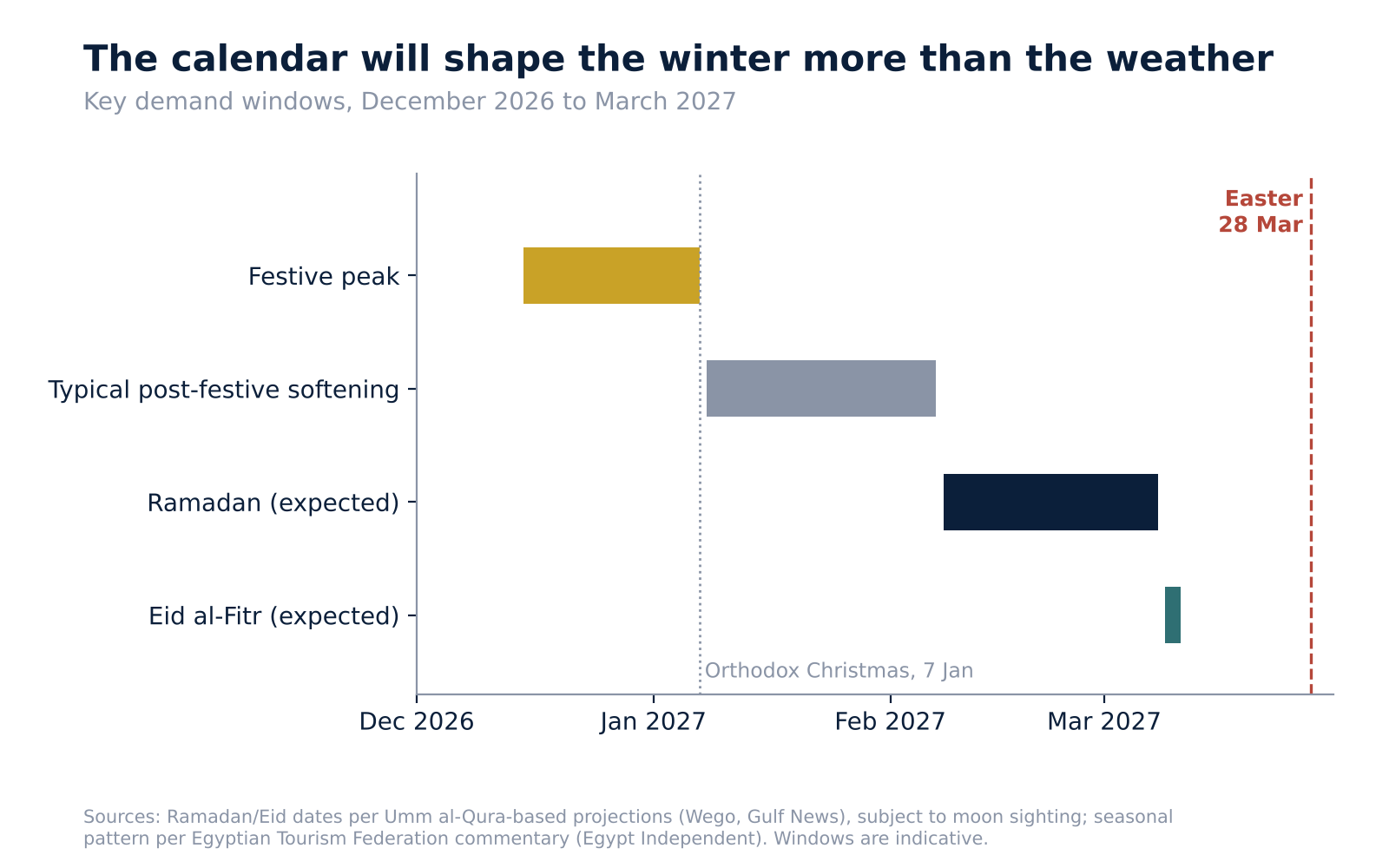
The calendar is unusually demanding. The festive peak is followed by the traditional January lull, and Ramadan is expected to begin around 8 February, so February will largely be a Ramadan month.
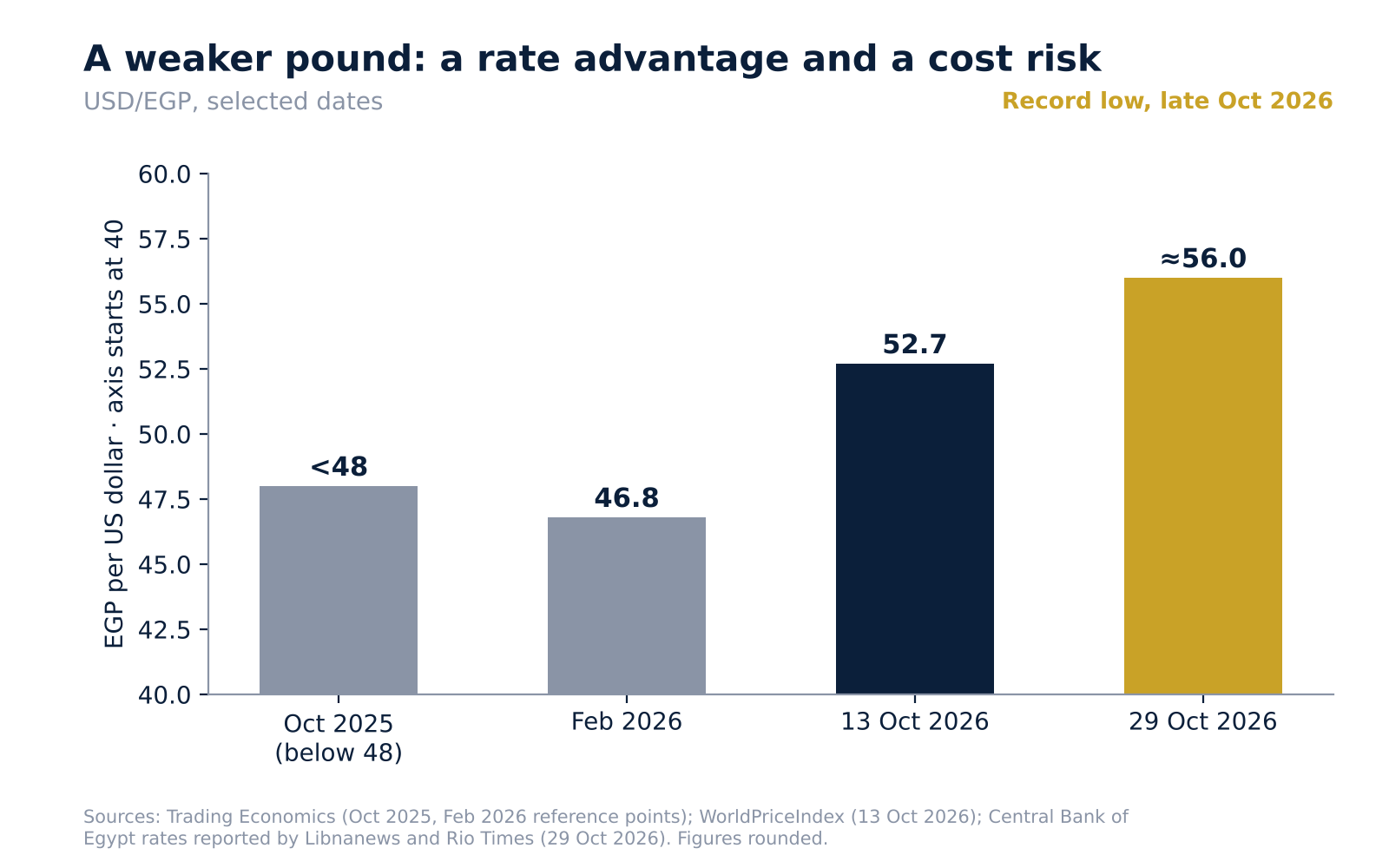
The pound is the biggest planning variable. It touched a record low near 56 per US dollar in late October, from about 47 in February, while the central bank raised rates to 20%.
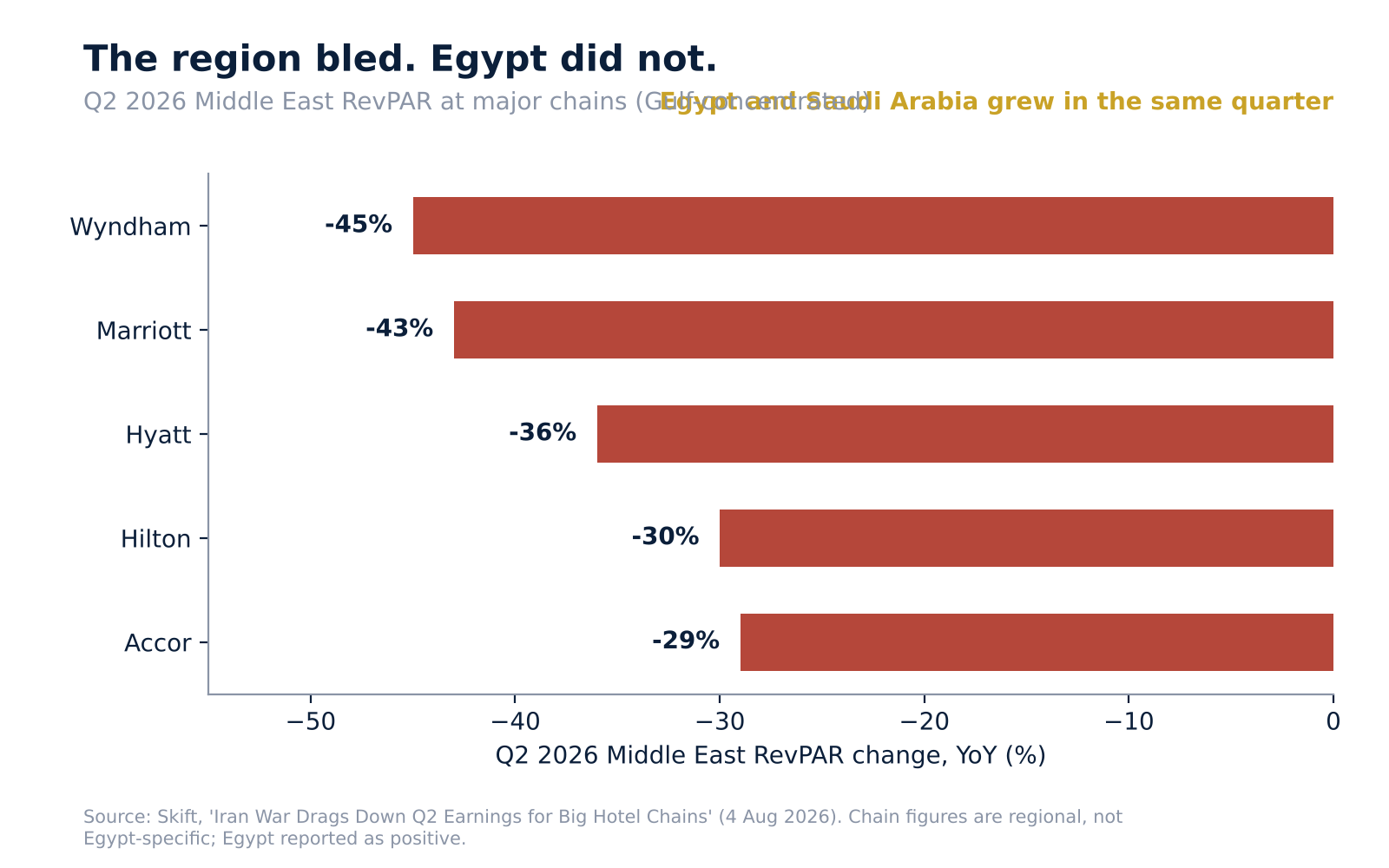
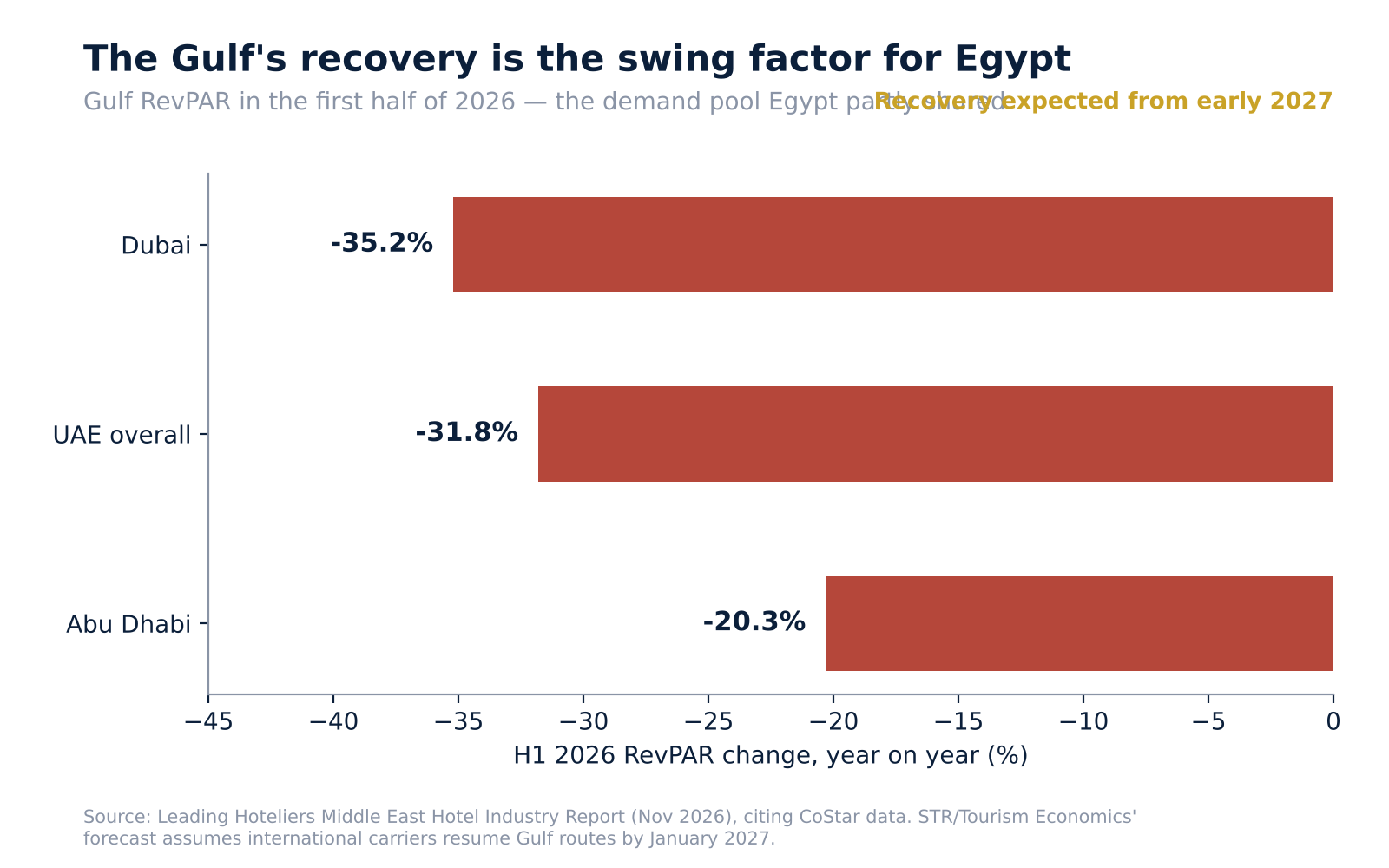
Geopolitics remains the swing factor. Gulf aviation is recovering but unevenly. How fast it normalises will influence whether Egypt keeps the diverted demand it enjoyed in 2026.
Forecast ranges, not points. The winning approach this season is a base, upside and downside case with clear trigger points for re-forecasting.
Where Egypt starts from
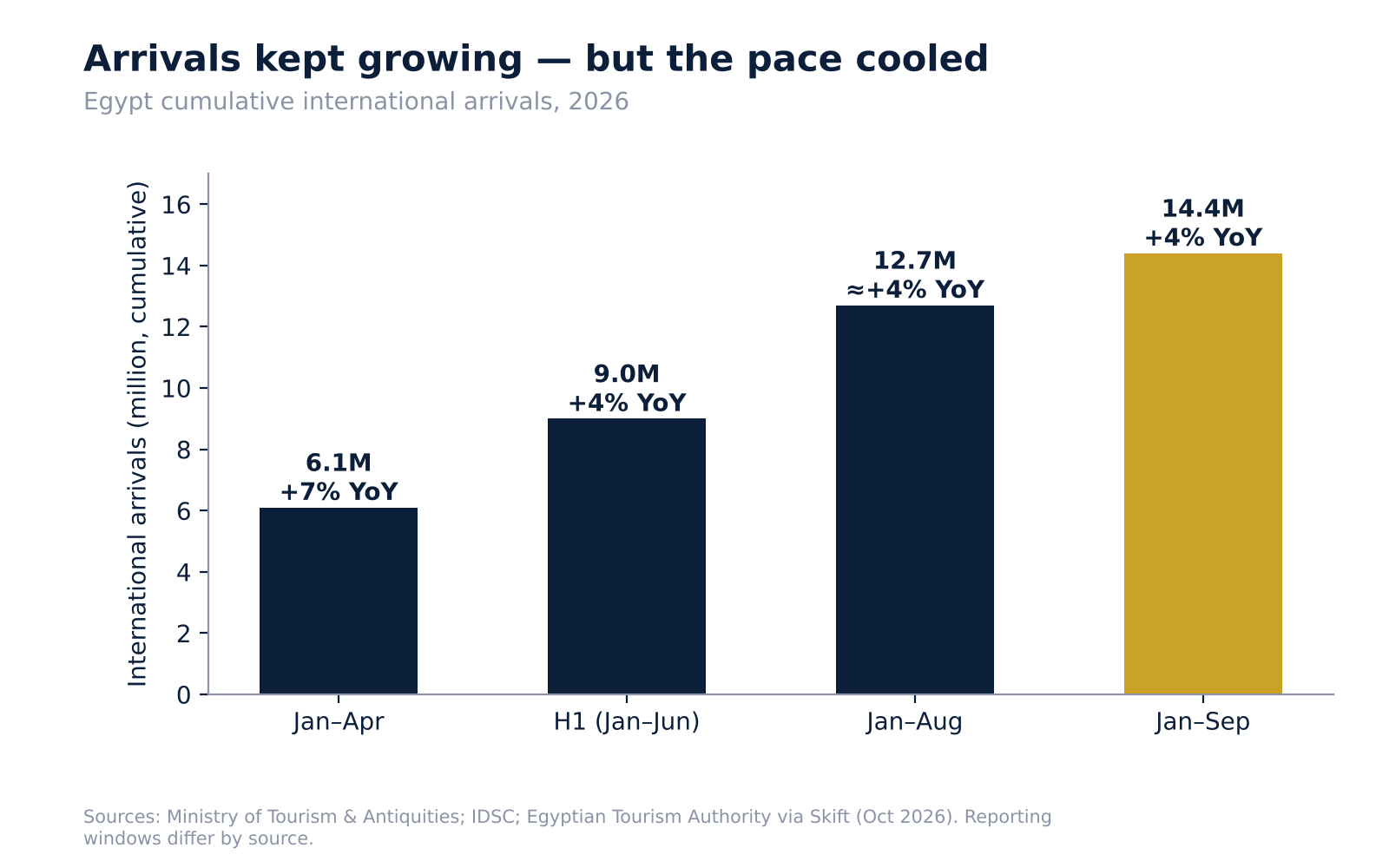
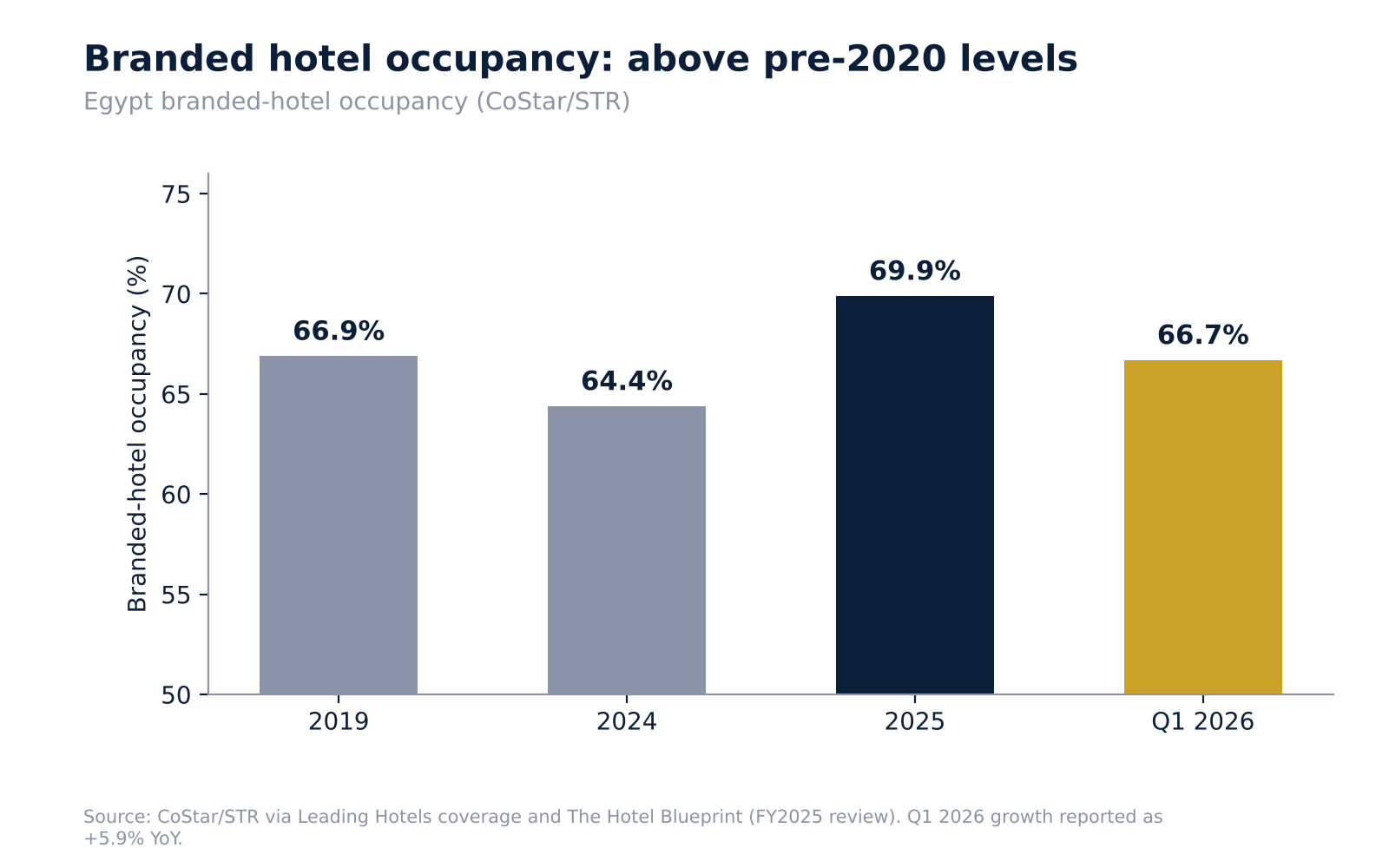
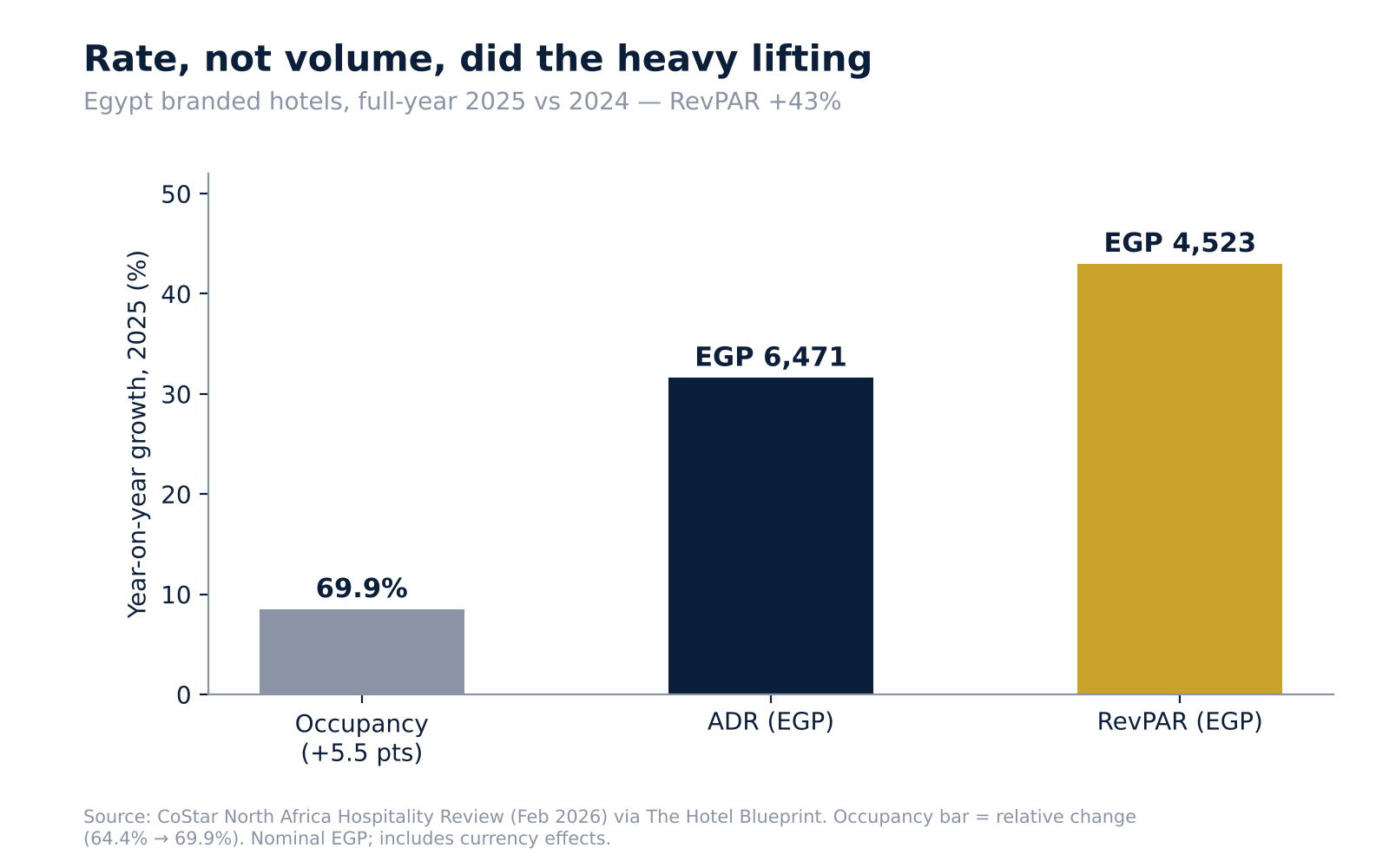
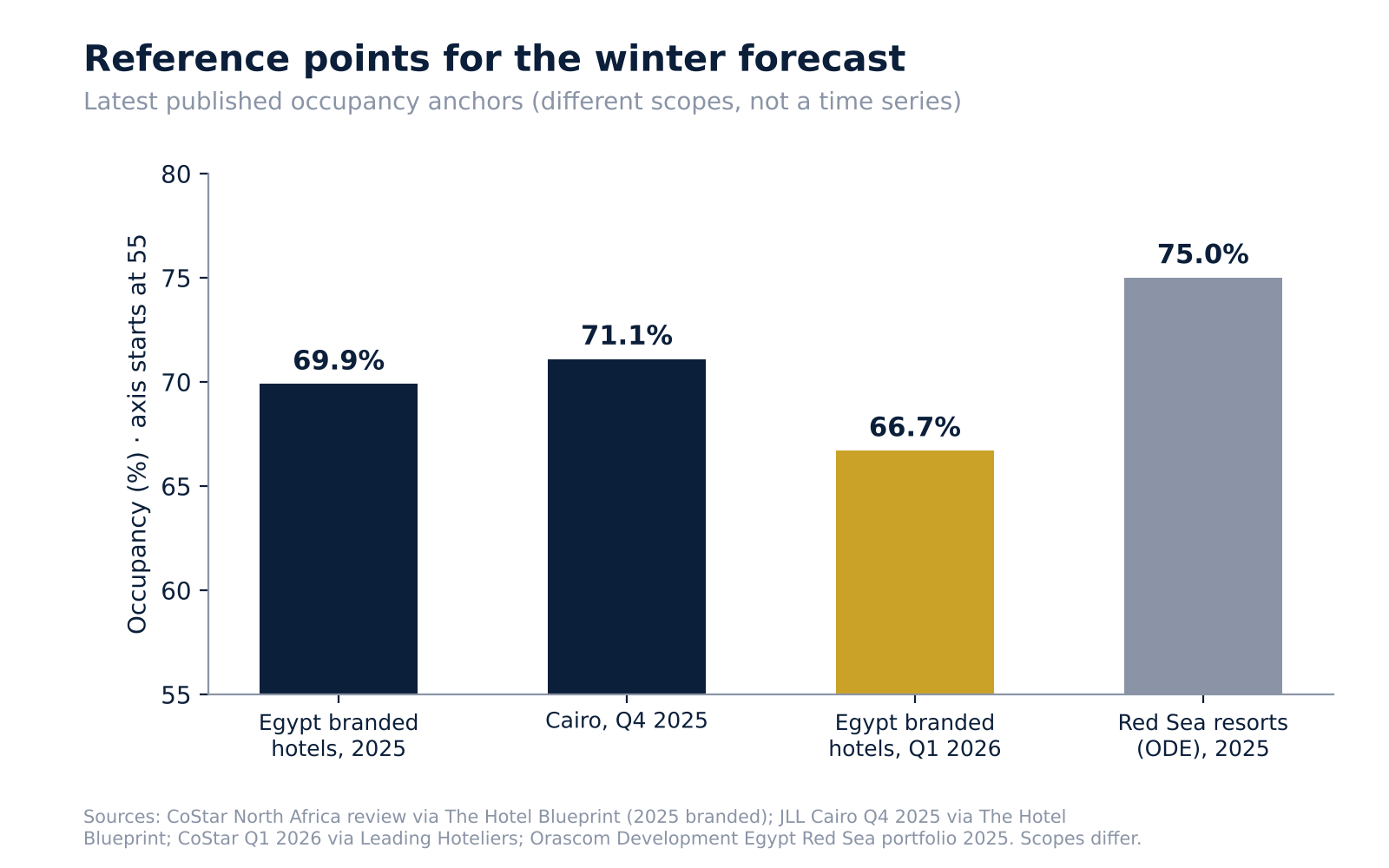
The baseline is strong. CoStar's North Africa review put branded-hotel occupancy at 69.9% for 2025, with RevPAR up 43% year on year. Cairo closed the winter 2025 window at around 71% occupancy, according to JLL, and Q1 2026 branded occupancy was reported at 66.7%. Through the summer, Hurghada reported near-full hotels, and cumulative arrivals reached about 14.4 million in the first nine months of 2026, roughly 4% above last year.
Two cautions apply when you use these numbers as a launch pad. First, they are nominal Egyptian-pound figures and carry currency and inflation effects. Second, they mix scopes, from national branded hotels to a single operator's Red Sea portfolio, so they are reference points rather than a clean time series.
What December could look like
December is shaped by two forces: the European winter-sun season and the festive window. Industry commentary has traditionally placed Egypt's peak in the second half of December and the first week of January. Evidence for this winter points the same way. Beyond TUI's ranking, Condor, Wizz Air and Air Cairo have added or extended Red Sea and Cairo routes for the season, and Jet2 is preparing its return to the Egyptian market, with 18 weekly flights planned from seven British airports to Hurghada and Sharm El Sheikh from 2027.
The working assumption for planners is a strong festive period at the Red Sea resorts, with Cairo and Luxor supported by cultural tourism and the Grand Egyptian Museum. The risk is not demand but price discipline: a record pound weakness makes foreign-currency rates look cheap, and the temptation to discount early can leave money on the table in the peak weeks.
What January could look like
January is typically softer once the festive window closes. Egyptian Tourism Federation commentary in past seasons describes occupancy easing through January and February before recovering from March. That pattern is the reasonable base case again, with resort markets more exposed than Cairo.
This is also the month where the Gulf story could start to bite. STR and Tourism Economics have deliberately not upgraded their Q4 2026 Middle East forecasts, but have raised expectations from Q1 2027 on the assumption that international carriers resume Gulf routes by January. If that happens, some leisure travellers who diverted to Egypt in 2026 may return to the Gulf. If it slips, Egypt keeps more of that demand. Either way, January bookings made in November and December are your best early signal.
What February could look like
February carries the new variable. Ramadan is expected to start on or around 8 February 2027 and run to about 8 March, with Eid al-Fitr on 9 or 10 March, subject to moon sighting. Western Easter follows on 28 March.
STR's regional commentary offers a useful precedent from the last time Ramadan overlapped a high season. Markets with a larger international or leisure base held occupancy better, because non-Muslim travellers still travel. For Egypt, that means Red Sea resorts selling to European guests are relatively insulated, while Cairo, Alexandria and the business, events and domestic segments should expect a different rhythm: lower daytime food and beverage, stronger evening iftar and suhoor activity, and fewer corporate gatherings. Arab-market demand will be softer until Eid.
The currency question
The Egyptian pound crossed 56 per US dollar at the central bank in late October, a record low, and the central bank raised its key rates by one percentage point to 20% on 29 October. Reported inflation has eased to around 12% to 14%, depending on the measure.
For hoteliers this cuts both ways. A weaker pound makes Egypt cheaper for foreign guests, supporting volume and enabling rate growth in hard currency. But it raises the local cost of imported food, equipment, spare parts and energy, and it increases the burden of any foreign-currency debt. A hotel that raises its pound rates by 10% while the pound falls 15% is cutting its dollar price while its costs rise. That mismatch, not occupancy, is where winter margin will be won or lost.
Points to take into consideration when forecasting
Separate volume, rate and mix. Forecast occupancy, ADR and source-market mix independently, then combine. A flat occupancy line can hide a shift toward lower-yield tour-operator business.
Forecast in two currencies. Build the budget in Egyptian pounds and in your main contract currency, and show both. Year-on-year growth in pounds will look spectacular and may mean little in euros or dollars.
Use pace, not just history. Compare on-the-books reservations and pickup against the same date last year, and track cancellations. After a volatile year, last winter is an imperfect guide.
Model the calendar explicitly. Treat the festive window, the January softening, Ramadan and Eid as separate periods with their own demand assumptions, rather than as monthly averages.
Stress the Gulf assumption. Test what happens to your pace if diverted demand returns to the Gulf, and what happens if it re-escalates. The early November strikes reported near Iran's Qeshm Island are a reminder that the situation is not resolved.
Watch the cost side. Energy, food, labour and replacement costs are moving with the pound. STR has warned that hotel operating expenses are rising faster than general inflation in major markets, so protect flow-through, not just revenue.
Benchmark against your competitive set. Where you have STR participation, look at your index against your set. A strong month in a strong market may be the market, not you.
Respect data quality. Public figures for Egypt are inconsistent between sources and reporting windows. Treat headline growth claims with care, and rely on your own booking data first.
Advice for hotel decision-makers
Protect rate integrity in the peak weeks. Price the festive window on demand, not on competitors' discounts, and use length-of-stay and advance-purchase fences instead of blanket reductions.
Price in hard currency where contracts allow. Where you contract in pounds, shorten rate validity and add review clauses so a further move in the exchange rate does not erode your yield.
Plan February deliberately. Build Ramadan offers early: iftar and suhoor packages, staycations for local and Gulf families, and Eid bookings. Adjust staffing and outlet hours to the new rhythm rather than discovering it in the first week.
Lock in costs early. Buy long-lead and imported items before further currency moves where cash allows, and widen local sourcing for food and supplies.
Diversify source markets. Germany, the United Kingdom, Poland, Italy, the Nordics and Russia behave differently. A balanced mix reduces the damage from any single airline, advisory or currency shock.
Build a forecast rhythm. Re-forecast weekly on pace and monthly on scenarios, with agreed triggers: for example the confirmation of Gulf carrier schedules in January, the official Ramadan start date, and any change in travel advisories.
Keep a liquidity buffer. With rates at 20% and the pound volatile, avoid committing discretionary capital until the February picture is clear.
Three scenarios to plan around
Base case: steady resort strength, a softer Cairo February. European demand holds, the festive peak delivers, January eases as usual, and Ramadan reshapes the second half of February. Gulf routes return gradually.
Upside: calm returns early. Gulf carriers restore capacity by January and confidence recovers. Egypt benefits from better long-haul connectivity through Gulf hubs and from the new UK and European flights, while some diverted demand leaves. Net effect: healthy, but with more competition for the same guests.
Downside: renewed escalation or a currency shock. Airfares and fuel costs rise, cancellations increase and a further pound move squeezes costs. Resort markets with tour-operator dependence are most exposed to schedule cuts.
These are planning frames, not predictions. Each hotel should attach its own numbers to them using its own pace data.
Our point of view
The winter of 2026/27 is a test of discipline rather than demand. Egypt enters it with strong momentum, new airline capacity and a record pound weakness that makes the destination attractive. The hotels that benefit most will be those that resist the urge to chase volume, price by period rather than by month, manage costs against the currency, and treat the Gulf's recovery as a variable to monitor rather than a headline to react to.
We will return to this article once December, January and February data are published, and compare what the market delivered against these frames.
Sources
Travel And Tour World, "Egypt's UK Tourist Arrivals Surge 9.4% as New Flights and Winter Holidays Boost Travel Growth" (Nov 2026): travelandtourworld.com
Wikipedia, "Air Cairo" and "Hurghada International Airport" (winter 2026/27 route additions): wikipedia.org
Libnanews, "Egyptian pound: Central bank raises its rates" (4 Nov 2026): en.libnanews.com
Rio Times, "Egypt Raises Interest Rates to 20%" and "Egypt Inflation Slows to 12.0% in October" (Oct–Nov 2026): riotimesonline.com
Trading Economics, Egypt inflation rate and interest rate pages: tradingeconomics.com
WorldPriceIndex, Egypt exchange rates (13 Oct 2026): worldpriceindex.org
Hotel-Online / STR and Tourism Economics, "Europe Hotel Growth Slows as ADR Carries RevPAR Gains; Asia Pacific and Middle East Show Resilience" (Oct 2026): hotel-online.com
Leading Hoteliers, "The Middle East Hotel Industry Report: The Bifurcated Recovery, the Pipeline Paradox, and the Profitability Imperative" (Nov 2026): leading-hoteliers.com
AGBI, "Winter schedules reveal the resilience of Gulf aviation" (3 Nov 2026): agbi.com
Aviation Week, "Arab Airlines Forecast Fast Bounceback If Peace Returns To Middle East" (3 Nov 2026): aviationweek.com
Gulf News, Dubai Standard and The Traveler, Gulf flight and security updates (Nov 2026): gulfnews.com, dubaistandard.com, thetraveler.org
Wego and Gulf News, "When is Ramadan 2027?": blog.wego.com, gulfnews.com
CoStar / STR, "Middle East & Africa hotel performance update" (Ramadan and high-season overlap): costar.com
Egypt Independent, "Egypt's hotels increase room rates by 7-15 percent" (seasonal pattern commentary): egyptindependent.com
The Hotel Blueprint, "Hotel Performance Review: Egypt, Full Year 2025" (CoStar and JLL data): thehotelblueprint.com
Skift, "Egypt Has the Visitors. Now It Wants Them to Stay Longer and Spend More" (29 Oct 2026): skift.com