Cultural-heritage tourism already earns Egypt higher yields and more repeat visitors than its beach resorts yet the industry that depends on that culture is investing far more in getting tourists in front of it than in helping them actually experience it.
Ahmed Mahfouz·Founder & Editor, Tourism Club·September 2026·10 min read
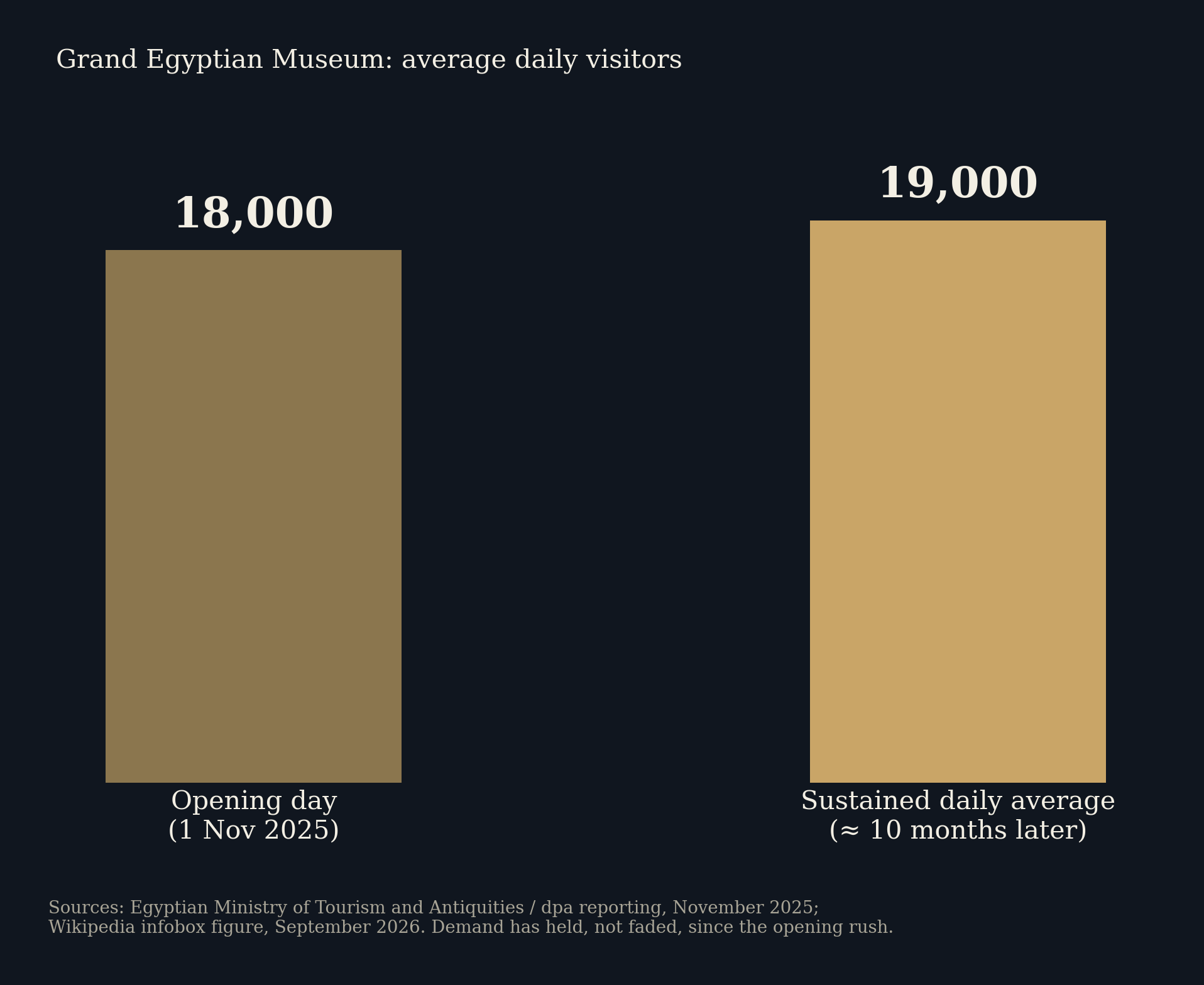
Ten months after it opened, the Grand Egyptian Museum is still drawing roughly 19,000 visitors a day slightly more than it welcomed on its first full day open to the public in November 2025, when the country celebrated the opening with 79 official delegations and a global broadcast. That number matters less as a museum statistic than as a market signal. It says the appetite for Egypt’s civilisation, when it is presented with real depth and care, is not a marketing story. It is genuine, sustained demand, still holding nearly a year on.
The harder question is what happens to that appetite everywhere else in the country on a felucca crossing timed to the minute, in a taxi surrounded by vendors at the Giza gate, in a five-minute “folklore show” standing in for an oral epic that traditionally ran for days. Egypt is not short of culture to sell. What is less certain is whether its tourism industry, as currently built, is set up to deliver that culture or only to sell tickets to look at it.
The Central Question
Egypt has one of the deepest living cultures on earth to offer travellers so is its tourism industry built to deliver that culture, or only to sell tickets to look at it?
Culture Already Outperforms — Egypt’s Own Hotel Market Proves It
Tourism Club has previously reported on the divide inside Egypt’s hotel market: a high-volume Red Sea resort circuit built on thin margins and price-sensitive charter tourism, against a Cairo-Luxor-Aswan cultural heritage circuit that generates measurably higher yields and more repeat visits, according to a March 2026 assessment by travel analysis firm Skift Advisory, reported by regional business publication AGBI. That finding deserves more attention than it has received. It means Egypt’s own market has already run the experiment on whether culture is worth more to a traveller than sun and sand and culture won.
The Grand Egyptian Museum’s attendance is the clearest live evidence of why. On its first public day in November 2025, the museum drew around 18,000 visitors. Ten months later, with the opening spectacle long over and no head of state in the room, the daily average is still about 19,000 higher, not lower. Museums built on hype fade within weeks. A museum still adding visitors nearly a year after launch is being sustained by something else: the depth of what is actually inside it, more than 100,000 artefacts including the complete 5,398-piece Tutankhamun collection, displayed together for the first time anywhere.
Egypt’s Cultural Balance Sheet Is Larger Than the Industry’s Investment in It
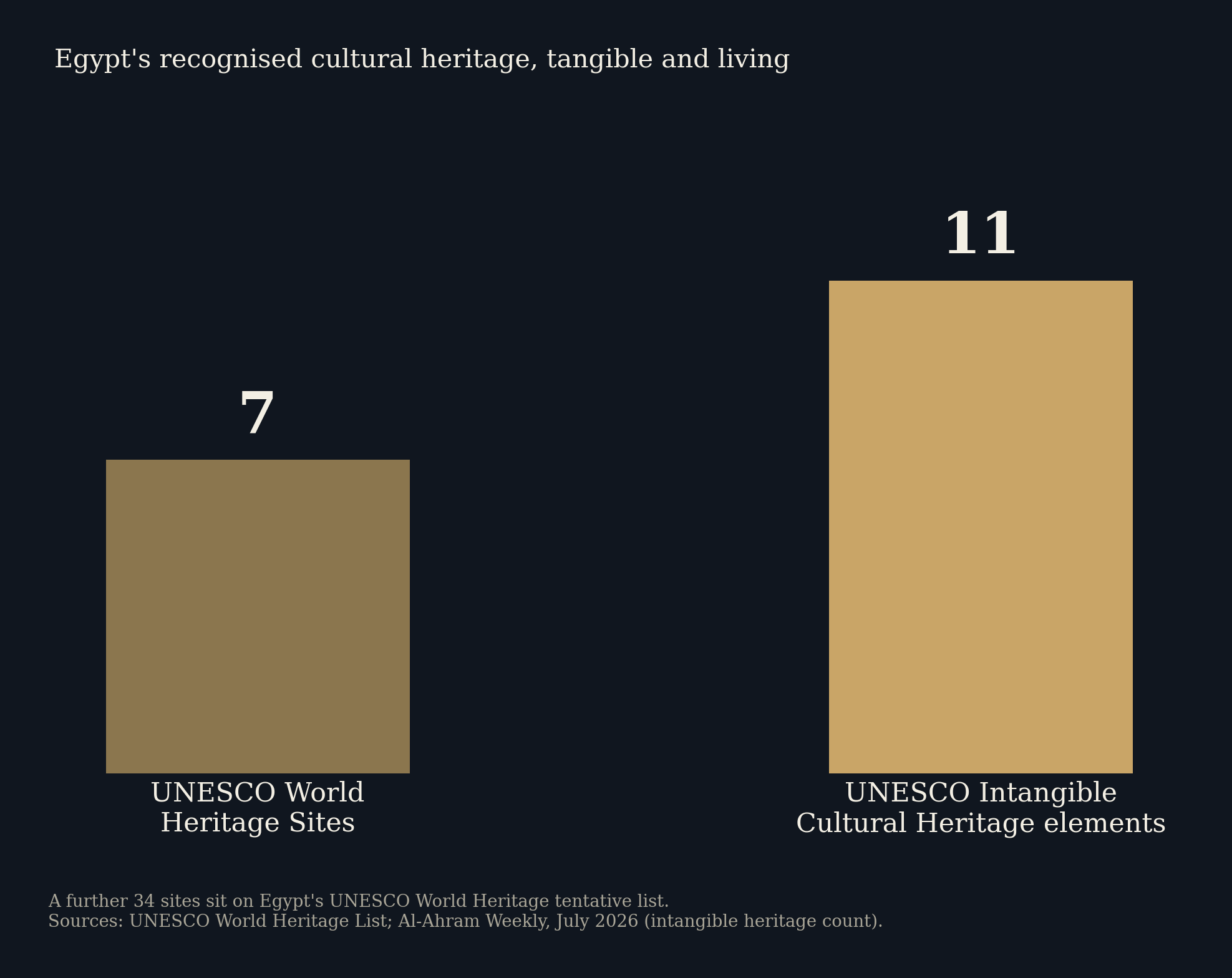
Egypt holds seven UNESCO World Heritage Sites Historic Cairo, the Memphis pyramid fields from Giza to Dahshur, Ancient Thebes and its necropolis, the Nubian monuments from Abu Simbel to Philae, the Saint Catherine area, Abu Mena, and the natural site of Wadi Al-Hitan with a further 34 sites on the country’s tentative list awaiting future inscription. Less widely known is that Egypt has spent the past two decades methodically registering its living culture as well: 11 elements are now inscribed on UNESCO’s Representative List of the Intangible Cultural Heritage of Humanity, from the Al-Sirah Al-Hilaliyyah oral epic and the tahteeb stick-fighting art to Arabic calligraphy, traditional hand puppetry, henna, metal engraving and, most recently, koshari the everyday rice, lentil and pasta dish sold on street corners across the country.
As Nahla Emam, a professor of folk customs and a UNESCO expert on intangible cultural heritage, has noted, Egypt’s regional diversity compounds this depth: the traditions of Upper Egypt differ from those of Lower Egypt, which differ again from the Canal cities, Sinai and the oases a range of living culture that few competing destinations can match with a single national identity.
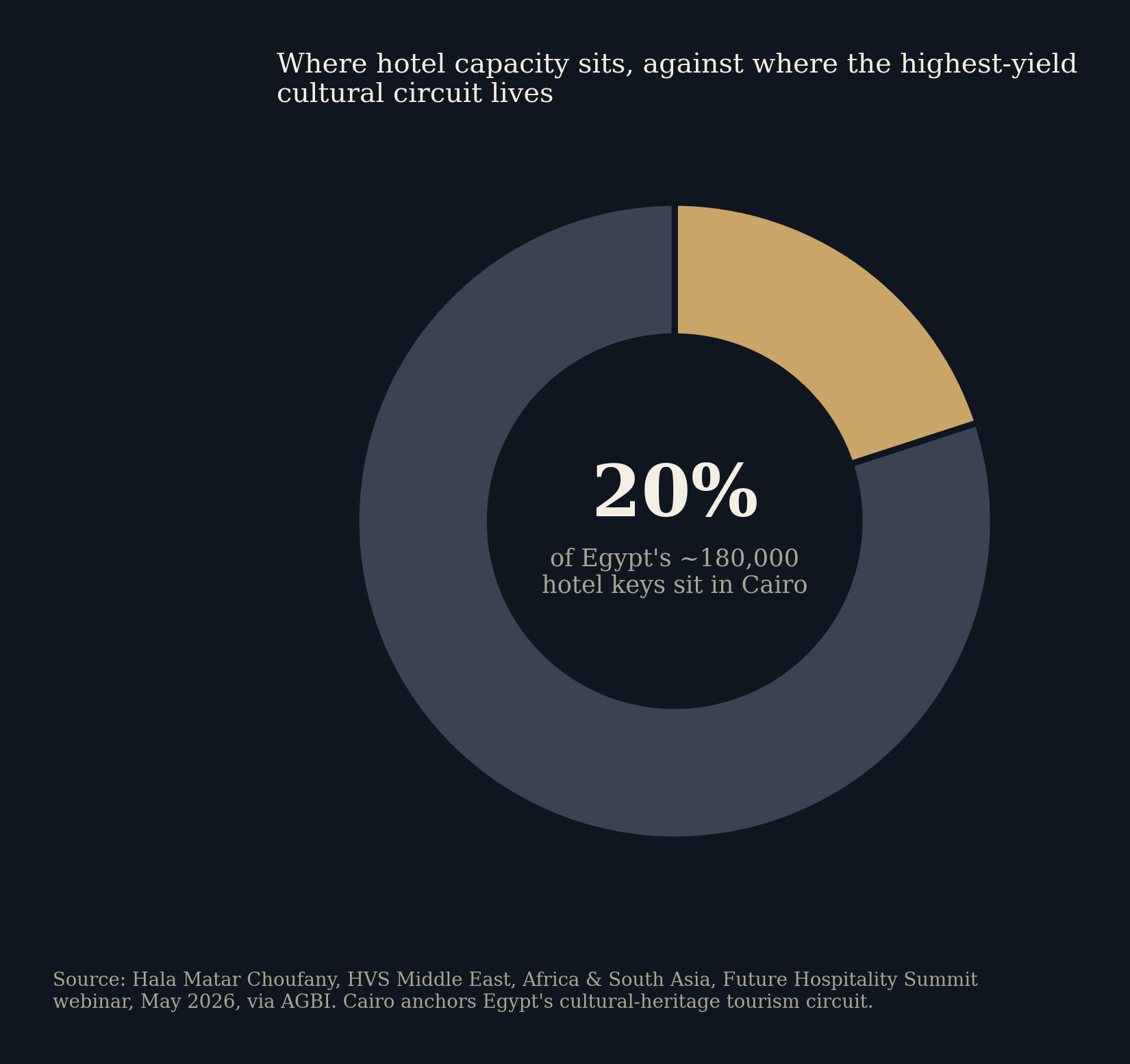
Yet the country’s own hospitality investment does not track where this asset actually sits. Only about 20 percent of Egypt’s roughly 180,000 hotel keys are located in Cairo, according to Hala Matar Choufany, president of HVS Middle East, Africa and South Asia the city anchoring the higher-yield cultural circuit alongside Luxor and Aswan. Most of the record hotel pipeline Tourism Club has previously documented continues to chase Red Sea beach and resort markets instead, the segment already shown to generate thinner margins. Capital is not following the yield data.
The Culture That Reaches the Tourist Is Often the Short Version
The Al-Sirah Al-Hilaliyyah epic is a useful case study in what happens when living heritage meets a tourism industry under commercial pressure. In its complete form, the epic can run to a million lines of verse traditionally performed over days at weddings and ceremonies by poets who began ten-year apprenticeships at the age of five. UNESCO’s own documentation of the tradition notes that, under pressure from the tourism industry, poets increasingly forsake the full repertory in favour of brief passages performed as folklore shows, and that the number of practitioners is dwindling as fewer young people commit to the training. A piece of heritage significant enough to be inscribed as part of humanity’s intangible cultural record is, in practice, being worn down by the very industry that markets Egyptian culture to the world.
A more visible version of the same tension plays out daily at Egypt’s single most recognisable site. Persistent touting and aggressive vending around the Giza pyramids vendors pressing tourists to take carriage or camel rides, sometimes surrounding vehicles at the gate has been documented for well over a decade, serious enough that Egypt’s parliament passed a law in 2018 imposing fines of up to EGP 10,000 on anyone found pestering tourists to beg, promote or sell, and serious enough that the government had earlier established a dedicated Giza Plateau Committee, drawing on the ministries of antiquities, tourism and interior alongside local residents, to manage the friction between the site and the community living beside it. The underlying culture at Giza is not in question it is one of the seven wonders of the ancient world. The quality of the encounter a visitor actually has with it, in the first and last minutes at the gate, remains an unresolved management problem.
The Question the Industry Should Be Asking
Is Egypt marketing its civilisation, or curating it?
Marketing a civilisation is cheap and scales easily: a claim about five thousand years of history works on a billboard in any language. Curating it is slower and more expensive it means protecting the full-length version of a dying oral epic, training and paying site staff to replace informal touting with a better visitor experience, and building itineraries around specific, well-explained traditions rather than a general sense of antiquity. The yield data from Cairo, Luxor and Aswan, and the sustained queue at the Grand Egyptian Museum, both point the same direction: travellers are already paying a premium for the curated version when it is offered. The industry’s investment pattern has not caught up with what its own customers are telling it.
Expert View
“Many people expressed a desire to visit Egypt to try it.”
Nahla Emam
Professor of Folk Customs; UNESCO Expert on Intangible Cultural Heritage
What This Means
Emam made the comment about koshari, the street dish Egypt successfully registered on UNESCO’s Intangible Cultural Heritage list a single, specific, well-documented element of everyday culture that, once formally recognised and explained, created verifiable travel intent on its own. The same pattern followed the opening of the Grand Egyptian Museum, she noted, with visible growth in interest in seeing Egyptian culture more broadly. The lesson generalises: narrow, well-curated specificity appears to convert into travel demand more reliably than broad claims about ancient civilisation ever do which argues for treating each of Egypt’s 11 registered traditions, and the many more still unregistered, as a distinct product to be curated rather than a footnote to the pyramids.
Who Gains, and Who Is Left Out of the Value Chain
Formal recognition of a cultural element creates a real, if uneven, economic benefit. UNESCO’s nomination process requires countries to identify the “bearers” of a tradition for koshari, that meant not only the restaurants serving it but the farmers growing the rice, lentils and onions it depends on, all named as stakeholders in Egypt’s official submission. Craft economies tied to metal engraving, weaving in Upper Egypt and Arabic calligraphy gain a comparable, if smaller, boost in visibility and legitimacy once inscribed. Cairo’s hospitality sector, already capturing the yield premium documented above, benefits directly from every visitor whose itinerary extends beyond the pyramids into the old city.
The group left out is harder to see precisely because it sits outside any formal registration process: tradition-bearers whose full-length practice is being economically squeezed into shorter, tourist-ready versions, and informal workers around major sites vendors, touts, unlicensed guides whose livelihood depends on the very friction that damages the visitor experience, because no better-paid, better-structured channel exists for them to participate in tourism’s economy. Neither group shows up in an arrivals count or a museum attendance figure. Both are part of the same cultural asset the industry is monetising.
What Most Discussions of Egyptian Tourism Overlook
The industry still measures cultural tourism success primarily by monuments visited and tickets sold not by how much of the living, regionally distinct culture Emam described actually reaches a visitor’s experience. A traveller can complete all seven UNESCO World Heritage Sites in a week-long itinerary and encounter none of the 11 living traditions on Egypt’s intangible heritage list, beyond perhaps a shortened folklore performance and a souvenir cartouche. Globally, UNWTO’s Tourism and Culture Synergies research a dated but still widely cited benchmark put the share of international trips motivated by cultural interest at around 40 percent. Egypt’s own tourism marketing rarely distinguishes between a visitor who wants to see a monument and one who wants to understand a civilisation still being lived by 105 million people, even though the two groups likely respond to very different itineraries, and very different investment.
What This Means for Egypt Against Its Regional Competitors
Saudi Arabia’s AlUla and Jordan’s Petra are both building international cultural-tourism reputations from a comparatively narrow historical base, backed by enormous, sustained investment in presentation, infrastructure and storytelling. Egypt’s advantage is structural rather than financial: a depth spanning Pharaonic, Greco-Roman, Coptic, Islamic and Nubian civilisations, plus regionally distinct living traditions from Sinai to the oases, that no comparable capital programme elsewhere in the region can manufacture from scratch. That advantage is durable only if it is actually delivered to visitors with the same curatorial care competitors are putting into culture they have far less of.
What Should Industry Leaders Do With This?
The practical response follows from the evidence rather than from sentiment about heritage. Operators and destination managers can treat full-length versions of registered intangible traditions a complete Hilali epic performance, a real koshari-making session with a named family restaurant, a supervised metal-engraving workshop as bookable, premium products in their own right, rather than compressing them into hotel-lobby show format. Site management at high-traffic locations such as Giza can prioritise converting informal touting into structured, trained, fairly paid visitor-facing roles, addressing both the experience problem and the livelihood problem in the same move. Marketing can lean further into the koshari model specific, verifiable, story-led claims about one tradition at a time rather than repeating broad claims about ancient civilisation that no longer differentiate Egypt from any other historic destination. And new hospitality investment can weight itself more deliberately toward the Nile Valley cultural circuit, in closer proportion to the yield premium that circuit has already demonstrated.
What to Watch Next
A handful of signals will show whether this gap between cultural depth and cultural delivery narrows or widens. The first is the pace of new UNESCO intangible heritage inscriptions: joint Arab nominations covering the oud, palm weaving, the Arabian horse and traditional sailing boats are due before the Intergovernmental Committee in December 2026. The second is whether the Grand Egyptian Museum’s attendance holds through a second full year, past the novelty period that typically erodes a new attraction’s numbers. The third is whether new hospitality investment begins shifting toward the Cairo-Luxor-Aswan circuit at a pace that reflects its yield advantage, rather than continuing to concentrate in Red Sea resort development. And the fourth is whether any structured programme emerges to formalise the informal vendor economy around major sites a problem now old enough to have outlasted at least one law and one dedicated committee.
Tourism Club View
Egypt does not have a culture problem. It has one of the richest, most continuously inhabited cultural landscapes on earth, spanning more civilisations than almost any other country can claim, still practised by the people living inside it rather than preserved only behind glass. The evidence from its own hotel market shows that this culture, properly delivered, is worth more to a traveller than a beach chair and the evidence from the Grand Egyptian Museum shows the appetite for it is real and lasting, not a launch-week spike.
What Egypt has is a delivery problem: an industry that has, for understandable commercial reasons, optimised for getting the largest number of visitors past the largest number of monuments in the shortest time, rather than for the slower, costlier work of letting them actually experience the civilisation those monuments belong to. Closing that gap is not primarily a cultural preservation project, however much it matters as one. It is, on the industry’s own numbers, a commercial opportunity that Egyptian tourism has so far only begun to price correctly.
Tourism Club Journal · Specialised readings and analyses from inside the tourism and hospitality sectors.

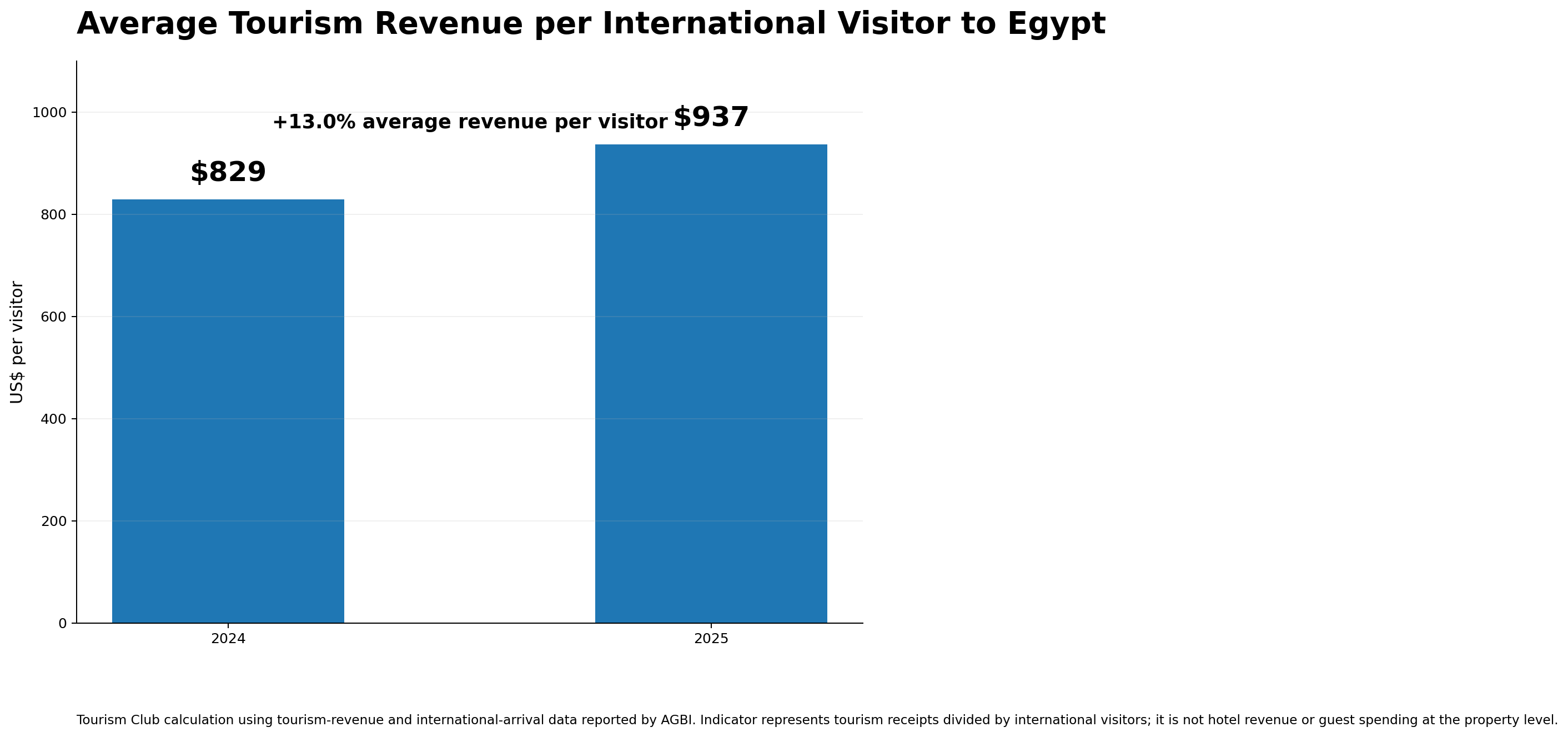 Average tourism revenue generated per international visitor to Egypt, 2024 vs. 2025. Tourism Club calculation from Central Bank of Egypt revenue data and Ministry of Tourism and Antiquities arrivals data, as reported by AGBI, June 2026.
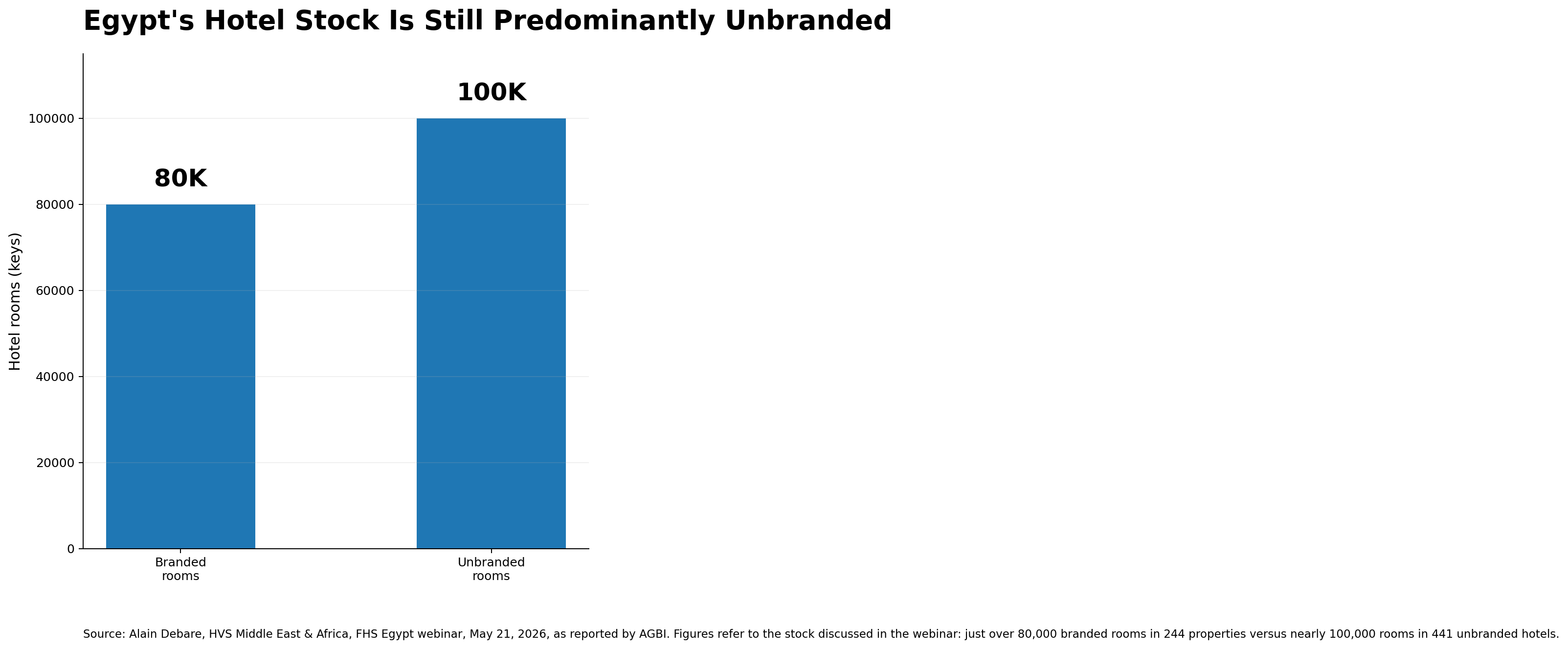 Egypt's branded vs. unbranded hotel stock. Source: Alain Debare, HVS Middle East & Africa, Future Hospitality Summit webinar, May 2026, via AGBI.
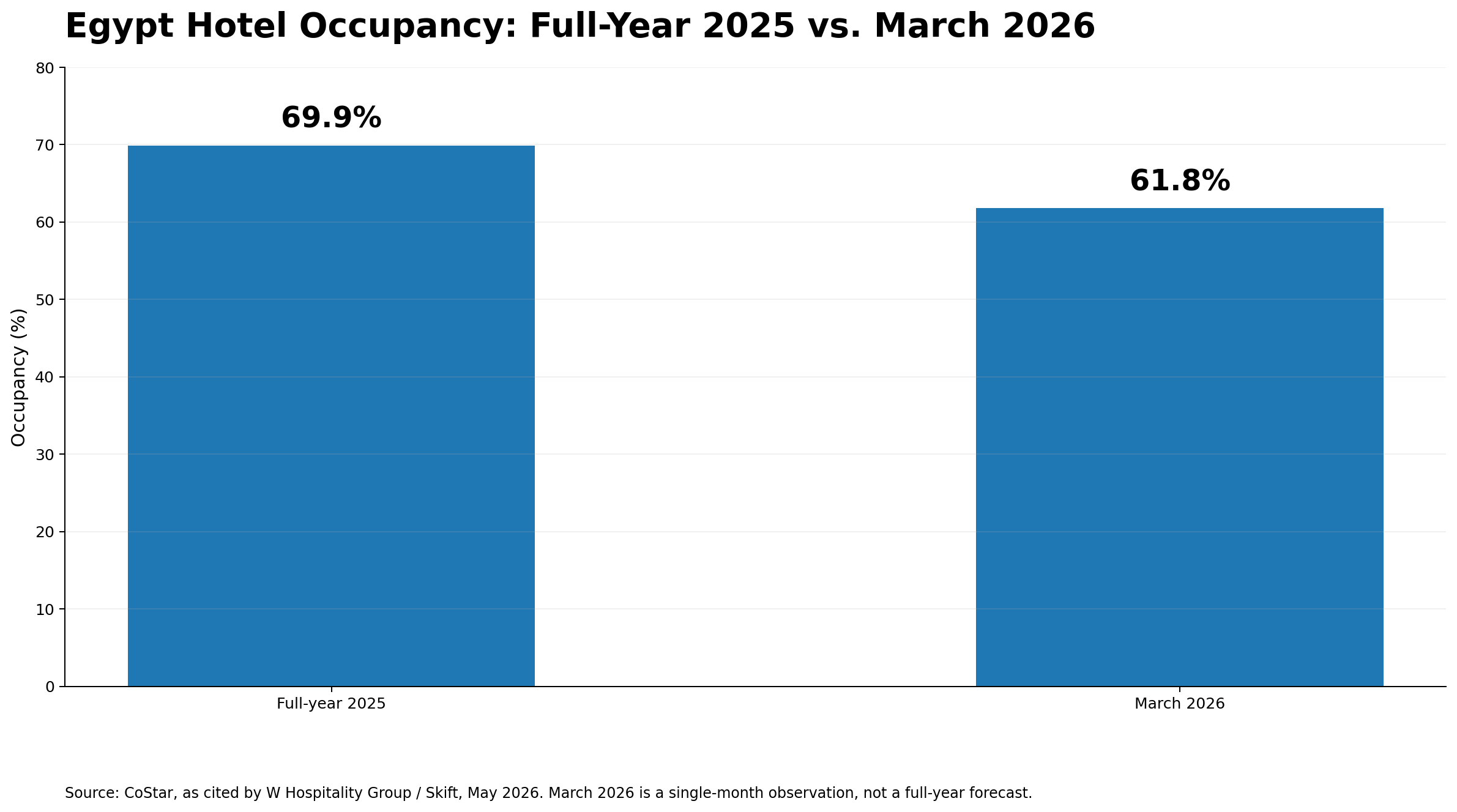 Egypt national hotel occupancy, full-year 2025 vs. March 2026. Source: CoStar, cited in W Hospitality Group / Skift reporting, May 2026.