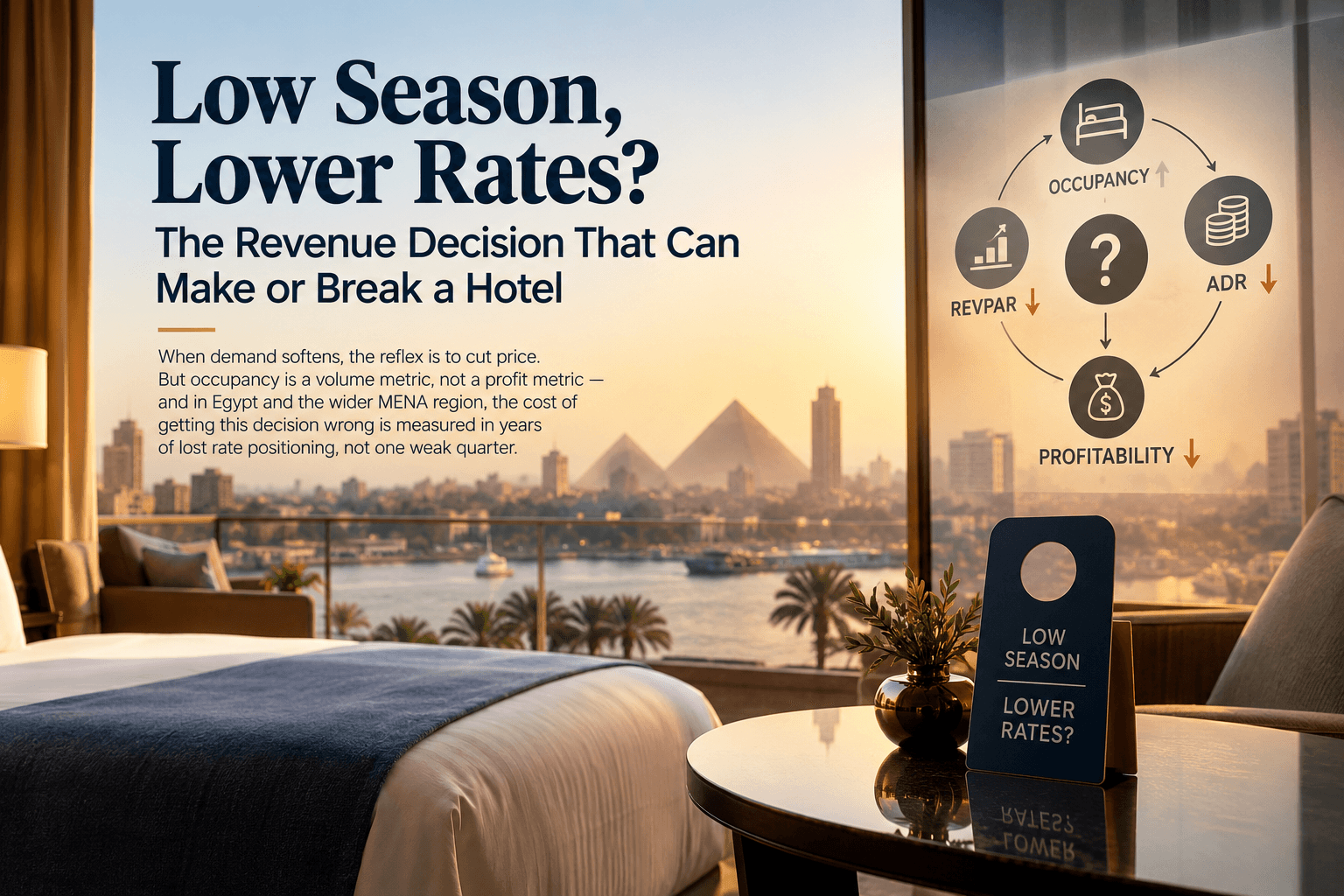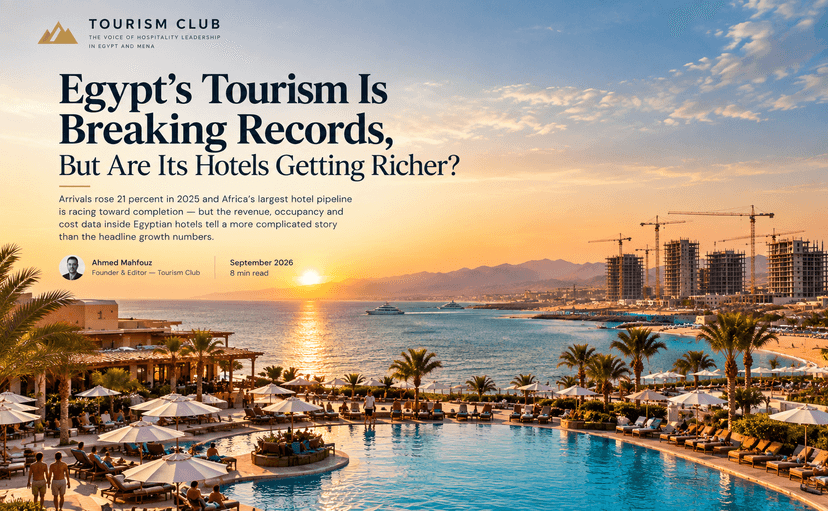
Arrivals rose 21 percent in 2025 and Africa's largest hotel pipeline is racing toward completion — but the revenue, occupancy and cost data inside Egyptian hotels tell a more complicated story than the headline growth numbers.
Ahmed Mahfouz Founder & Editor — Tourism Club Business & Investment | September 2026 · 13 min read
Hero Image Concept — creative direction only (not rendered)
A high-angle editorial photograph at golden hour: in the foreground, a fully occupied Red Sea resort pool deck, sun loungers packed shoulder to shoulder to the waterline — the visible proof of demand. On the horizon, in the same frame, cranes and the concrete skeletons of new hotel towers under construction, softened by haze. The two halves of the same picture argue with each other: one shows arrivals, the other shows supply arriving behind them. Warm, restrained colour grade — gold and terracotta tones rather than saturated travel-brochure blue — so the image reads as business analysis rather than vacation inspiration. Generous negative space across the upper third of the sky for headline overlay.
In January 2026, Egypt's government announced a number the country had never recorded before: 19 million international tourists in a single year, a 21 percent jump on 2024, a pace of growth that outran every destination on earth except Brazil. By any measure, it was a historic year for Egyptian tourism.
But a historic year for tourism is not automatically a historic year for a hotel's income statement. Ask a general manager in Hurghada, an owner in Alexandria, or an asset manager underwriting a new Red Sea development a narrower question — did revenue per available room grow anywhere near 21 percent last year? — and the answers scatter widely. Some will say yes. Many, especially outside Cairo's newest towers, will say the honest number was far smaller, that rate growth leaned on discounting rather than demand, or that rising costs absorbed most of the gain before it ever reached the bottom line.
That gap, between a national arrivals number and what actually lands inside a hotel's accounts, is not a rounding error. It is becoming one of the defining strategic questions for hospitality investment in Egypt over the next five years.
THE CENTRAL QUESTION If a country's tourism numbers keep climbing but a hotel's revenue does not climb in step, is that growth still good news for the hotel — or has it quietly become a source of risk?
The Visitor Count and the Revenue Count Have Stopped Moving Together
For most of the post-pandemic recovery, Egypt's tourism story was simple: more visitors meant more revenue, and the two figures moved closely enough together that nobody needed to separate them. The 2025 numbers broke that pattern. Arrivals rose 21 percent, according to the Ministry of Tourism and Antiquities. Tourism revenue, tracked separately by the Central Bank of Egypt, rose from $15.3 billion to $16.7 billion over the same year — real growth, but nowhere near the pace of the arrivals figure. Divide one by the other and a hotel-relevant number appears: the average revenue Egypt generated per international visitor fell from roughly $975 in 2024 to about $879 in 2025 — a decline of nearly 10 percent, in a year the government rightly celebrated as record-breaking.
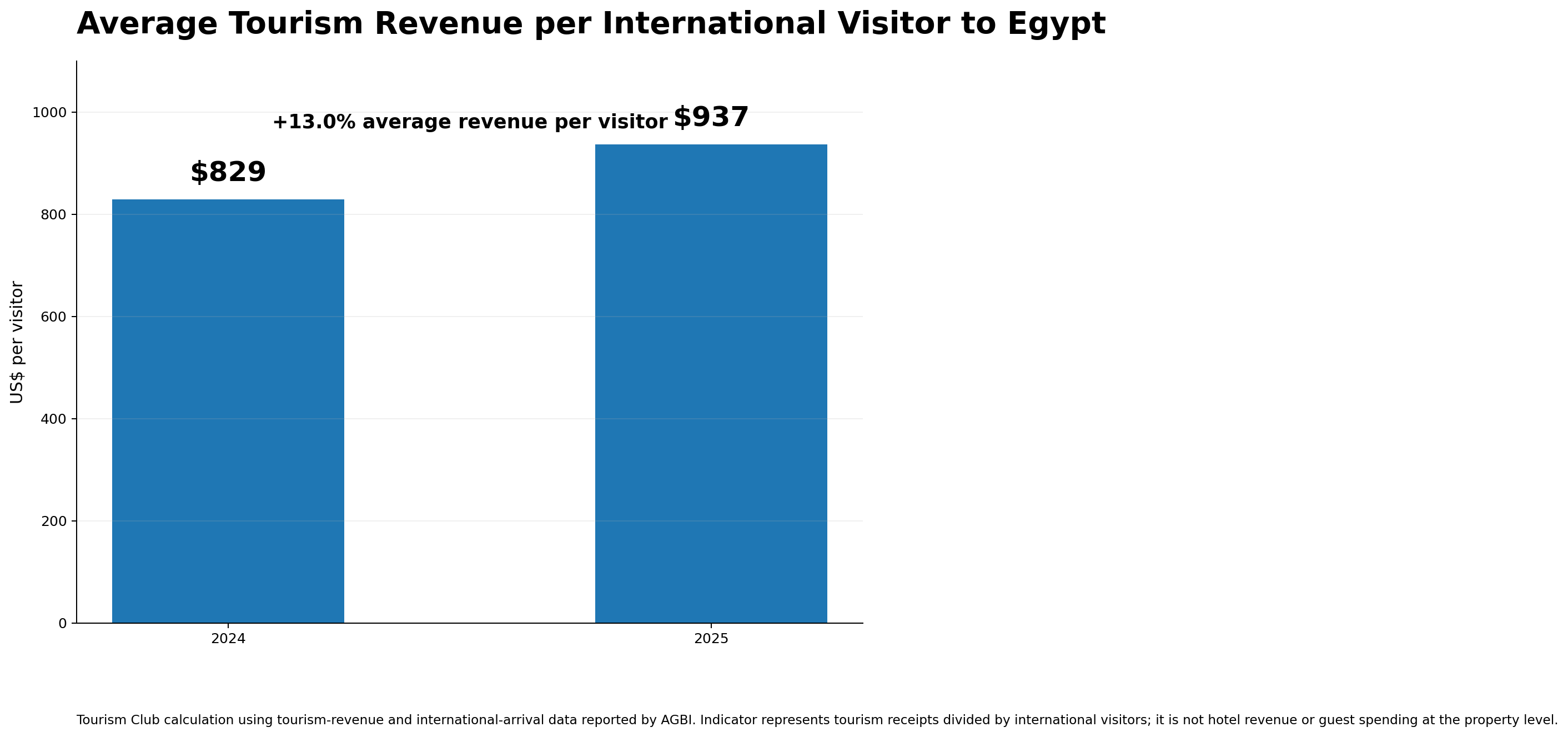 Average tourism revenue generated per international visitor to Egypt, 2024 vs. 2025. Tourism Club calculation from Central Bank of Egypt revenue data and Ministry of Tourism and Antiquities arrivals data, as reported by AGBI, June 2026.
This is not a uniquely Egyptian direction, but it is an unusual scale. UN Tourism's January 2026 World Tourism Barometer found that, globally, many destinations saw tourism receipts grow faster than arrivals in 2025 — a sign of travellers spending more per trip worldwide, with Morocco, South Korea and Japan among the strongest examples. Egypt still ranked among the world's best performers on both counts: second globally in arrivals growth, behind only Brazil, and among the top destinations for receipts growth. But UN Tourism's own figures put Egypt's 2025 receipts growth at 17 percent against 21 percent arrivals growth — meaning Egypt's own visitor volume outran its own visitor spending, even while beating almost everyone else's numbers on paper.
Egypt's Hotel Market Is Not One Market — It Is Two, Moving at Different Speeds
National averages hide a market that has split into two distinct tiers. Hotel data compiled by regional business publication AGBI in June 2026 shows national average daily rates climbing from about $80 to $132, and RevPAR from about $53 to $92 — genuinely strong growth, concentrated overwhelmingly in Cairo, where new internationally branded supply, the repositioning of legacy properties such as the Marriott Mena House and the Cairo Marriott, and the pull of the newly opened Grand Egyptian Museum have supported real pricing power.
Move away from Cairo, and the picture changes. Sharm El Sheikh and the wider Red Sea coast deliver Egypt's volume — strong occupancy, full charter flights, packed beaches — but on what advisory firms HVS and AGBI describe as thin margins, built on charter tourism from Central and Eastern Europe that is acutely price-sensitive. A March 2026 report by travel analysis firm Skift Advisory, summarised by AGBI, split Egypt's hospitality sector into two distinct businesses: a high-volume, lower-yield Red Sea resort circuit, and a higher-yield cultural heritage route through Cairo, Luxor and Aswan that generates stronger returns and more repeat visits. Skift's warning was specific: currency pressure could push hotels toward premature discounting on Red Sea rates, eroding the cultural circuit's pricing advantage at precisely the moment it most needs protecting.
The scale of the older, price-driven tier is larger than the headlines about Egypt's hotel boom suggest. Of Egypt's roughly 180,000 hotel keys, according to HVS Middle East & Africa partner Alain Debare, nearly 100,000 sit inside 441 unbranded, independently run hotels — more rooms than the entire branded segment of 244 hotels and roughly 80,000 keys combined. Only about 40 percent of the country's total hotel stock operates under a professional management agreement of any kind. This is the part of the market most exposed to the arrivals-versus-revenue gap: largely undifferentiated rooms, competing mainly on price, inside a market that just added a record number of visitors without a matching increase in what each one spends.
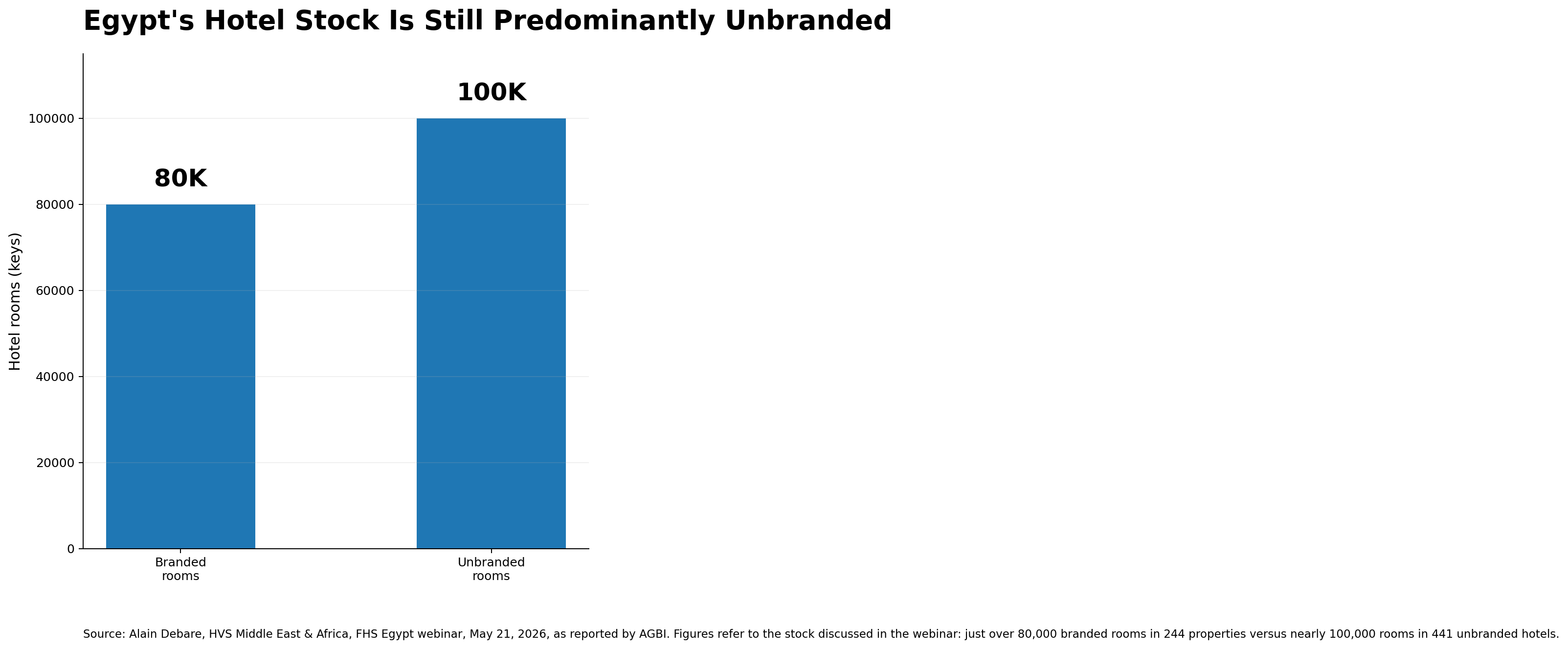 Egypt's branded vs. unbranded hotel stock. Source: Alain Debare, HVS Middle East & Africa, Future Hospitality Summit webinar, May 2026, via AGBI.
The Egyptian government has recognised this pattern for years. The Ministry of Tourism and Antiquities and the Egyptian Hotel Association maintain minimum accommodation price floors for Red Sea resort hotels — currently $50 a night for five-star properties and $40 for four-star, extending down to $10 for one-star hotels — specifically to stop what officials describe as price dumping, with inspection committees and the threat of legal action for hotels that undercut the floor. That a minimum price has to be set and periodically re-enforced by regulation is itself evidence that volume and value do not automatically move together in this market.
The Supply Behind the Boom Is Bigger Than the Boom Itself
If 2025's revenue-per-visitor gap were a one-year anomaly, it might not be worth building a strategy around. What turns it into a structural risk rather than a passing wrinkle is what is being built behind it. According to W Hospitality Group's 2026 Hotel Chain Development Pipelines in Africa report, Egypt's branded hotel pipeline reached a record 185 hotels and roughly 46,000 rooms in early 2026 — more than a third of the entire continent's planned supply, and about four times the pipeline of second-placed Morocco. That pipeline grew 35.5 percent in a single year, on the back of 53 new development deals signed in Egypt in 2025 alone, more than any other country in Africa. Greater Cairo's pipeline of 22,111 rooms across 88 projects is already the largest urban hotel pipeline on the continent.
A supply growth rate of 35.5 percent is arriving into a demand growth rate that is already slowing. Egypt's 21 percent arrivals surge in full-year 2025 cooled sharply in the first half of 2026: JLL's Q2 2026 Cairo Market Dynamics report recorded roughly 9 million international arrivals to Egypt in H1 2026, up just 4 percent year-on-year — a fraction of the prior year's pace, and broadly in line with UN Tourism's own forecast that global arrivals growth would normalise to 3 to 4 percent in 2026 after a stronger 2025.
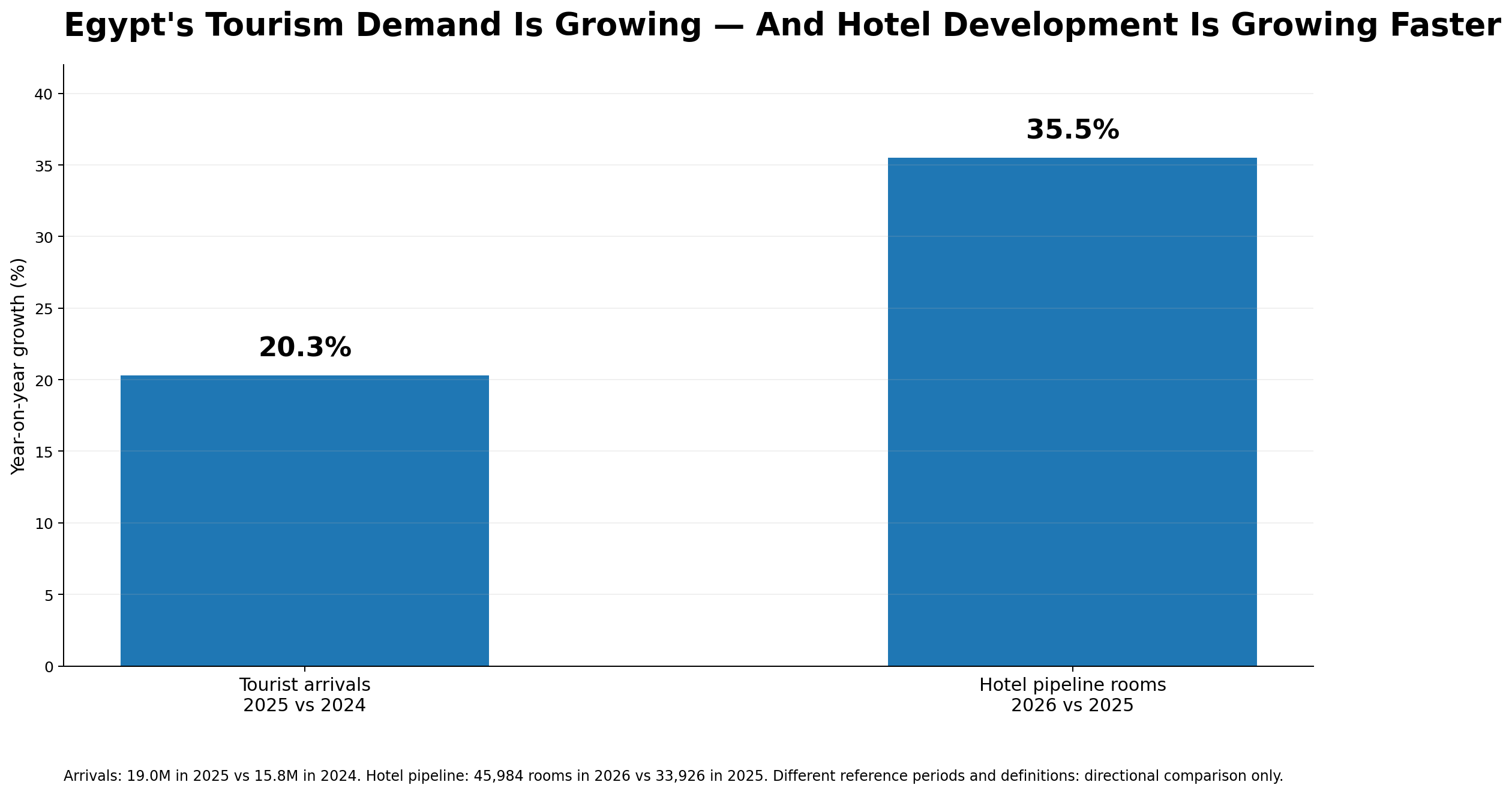
Egypt's hotel pipeline growth vs. arrivals growth. Sources: W Hospitality Group (2026); Egyptian Ministry of Tourism and Antiquities; JLL Cairo Market Dynamics, Q2 2026.
Early evidence of that gap opening up is already visible in occupancy. National hotel occupancy averaged 69.9 percent across 2025, according to CoStar data cited in industry reporting on Africa's hotel pipeline — then fell to 61.8 percent in March 2026. Part of that drop is ordinary seasonality; March sits outside Egypt's winter peak. But the size of the move, arriving alongside a pipeline expanding at more than eight times the current pace of demand growth, is the kind of gap that hotel economics eventually resolves through one of two channels: either occupancy absorbs the new supply and rates hold, or rates absorb it and margins compress. Neither outcome shows up in an arrivals headline. Both show up in a hotel's financial statements.
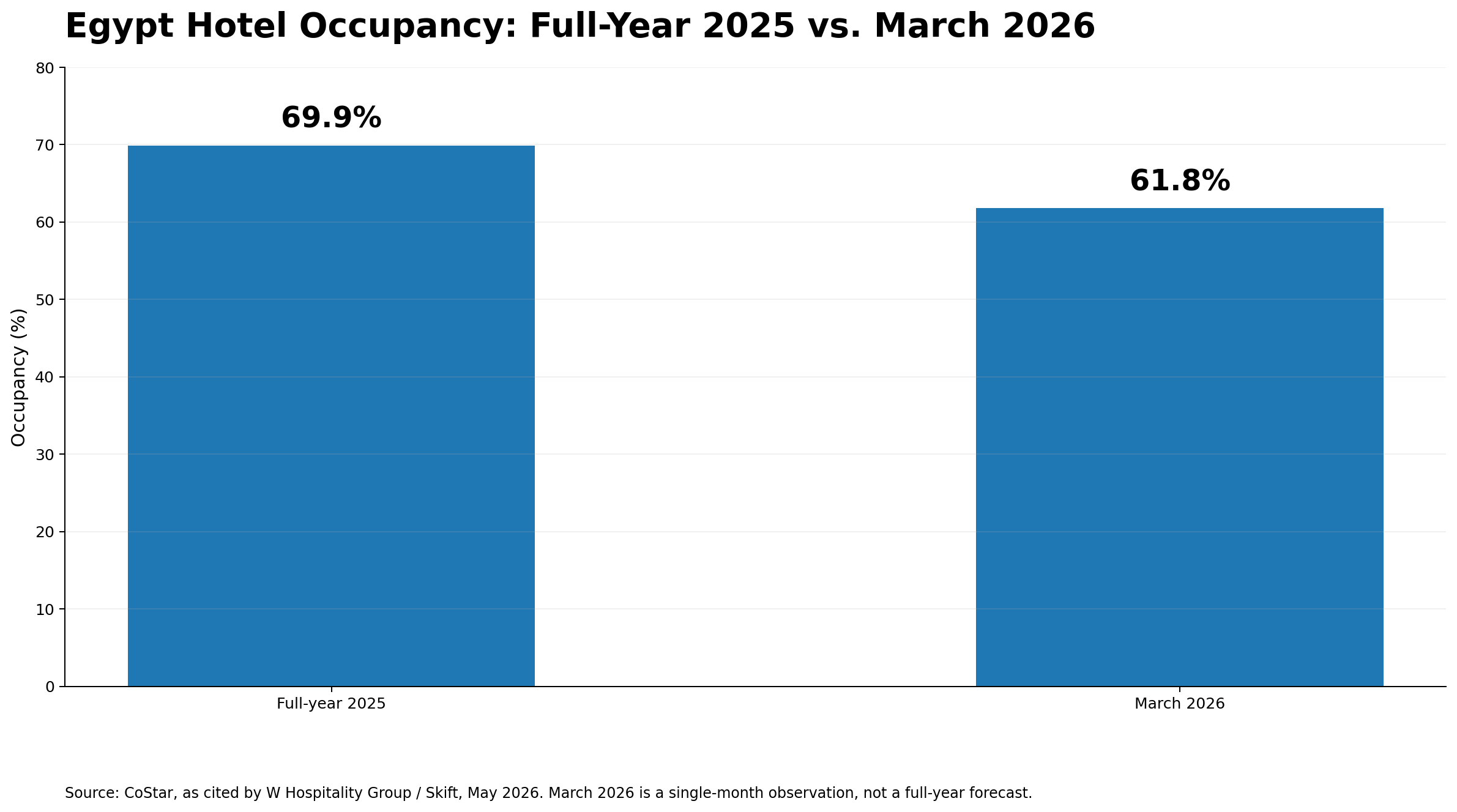 Egypt national hotel occupancy, full-year 2025 vs. March 2026. Source: CoStar, cited in W Hospitality Group / Skift reporting, May 2026.
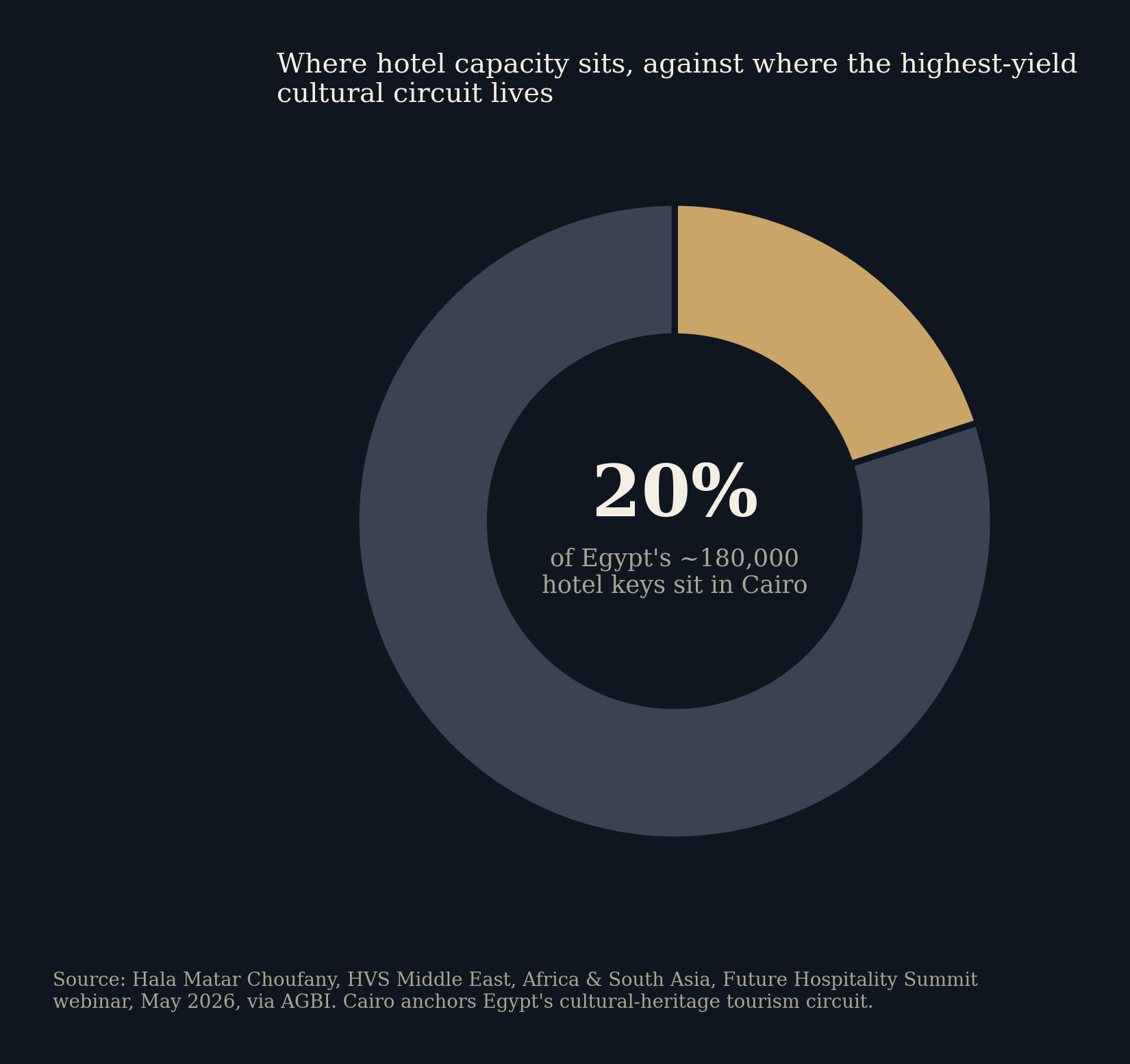
Hala Matar Choufany, president of HVS Middle East, Africa and South Asia, has pointed to a related imbalance: only around 20 percent of Egypt's 180,000 existing keys sit in Cairo, the segment generating the strongest pricing power, while most of the growth pipeline continues to chase the country's beach and resort markets. Her view, echoed by other advisors at a May 2026 Future Hospitality Summit webinar, is that upgrading and repositioning Egypt's existing stock — rather than continuing to add greenfield rooms at the current pace — is now the more realistic, and arguably faster, path to returns.
THE QUESTION THE INDUSTRY SHOULD BE ASKING Is 30 million the right number for Egypt's hotels to be chasing — or the wrong one?
Egypt's official target — 30 million international tourists a year by 2030 — functions as the industry's north star. Government statements, investor pitches and pipeline announcements are routinely measured against it. But an arrivals target, on its own, says nothing about whether the hotels receiving those visitors are becoming more valuable businesses.
That tension surfaced directly in comments reported in 2026 from Dr. Ghada Shalaby — a former vice minister at the Ministry of Tourism and Antiquities, now executive director of the Egyptian Hotel Association — who questioned the assumption embedded in the 30-million target itself. Hitting that number, she noted, would likely require roughly doubling the country's current room count, a build-out she does not consider realistic or, more importantly, necessary. The alternative she described is a shift in what the industry optimises for: fewer, better-yielding visitors rather than simply more of them, with return per guest treated as the real objective rather than the arrivals count on its own.
That is a genuinely different strategic question from the one currently dominating public conversation about Egyptian tourism. How many tourists Egypt can attract, and how much value an Egyptian hotel can generate per guest, are related questions — but they are not the same question, and pursuing the first one aggressively does not guarantee progress on the second. 2025's own numbers are the evidence.
EXPERT VIEW "We need to drive the return more than the numbers." Dr. Ghada Shalaby Executive Director, Egyptian Hotel Association · former Vice Minister, Ministry of Tourism and Antiquities
What This Means: Shalaby's comment, made in the context of Egypt's 30-million-tourist target, is a direct challenge to treating arrivals as the sector's primary scoreboard. Coming from the head of the trade body representing Egypt's hotel owners — rather than from a destination marketer, whose incentives run toward maximising visitor counts — the remark carries particular weight. It reframes this article's central question as one the industry's own leadership is already asking internally, even if it rarely reaches the headlines that accompany each new arrivals record.
Who Gains, and Who Is Left Holding the Risk
The benefits of Egypt's tourism growth are real and broadly shared at the macro level. The World Travel & Tourism Council estimated the sector's contribution to Egypt's GDP at roughly EGP 1.4 trillion in 2024 — about 8.5 percent of the national economy — with growth of around 4.9 percent forecast for 2025 and a rising GDP share. Government revenue, airport and infrastructure investment, and employment across a sector supporting well over two million jobs all move in the same direction as the arrivals headline, regardless of what happens inside any individual hotel's accounts.
Inside the sector, the picture is less even. Well-capitalised, professionally managed, branded hotels — particularly in Cairo, and particularly those able to reposition around the cultural heritage circuit — are positioned to capture real pricing power, evidenced by the national ADR climb from roughly $80 to $132, concentrated largely in this segment. Owners currently repositioning legacy Cairo assets are betting on this being the more durable growth story.
The more exposed position belongs to two overlapping groups: independent and unbranded hotels — nearly 100,000 of Egypt's roughly 180,000 keys — that compete primarily on price in a market where regulators have had to impose price floors to stop discounting; and new-build investors in the Red Sea pipeline whose underwriting assumed demand growth would continue at anything close to 2025's 21 percent pace, when the first half of 2026 delivered closer to 4 percent. Both groups are exposed not because Egyptian tourism is failing — arrivals remain at record levels — but because their business models depend on revenue keeping pace with volume, and 2025's own data shows that assumption cannot be taken for granted.
What the Arrivals Number Doesn't Show: Costs Are Rising Too
A revenue gap is only half of the margin story; the other half is what it costs a hotel to earn that revenue in the first place. Egypt's official consumer price data shows the "restaurants and hotels" category rising 13.7 percent year-on-year as of March 2026, according to CAPMAS figures reported by Ahram Online — a cost inflation rate not far off the pace of the entire industry's revenue-per-visitor decline. Commercial electricity tariffs rose by roughly 20 percent from April 2026, part of a wider energy subsidy reform programme, while construction material costs — relevant to every hotel currently renovating, converting or building — climbed around 18 percent year-on-year, according to market research cited by Mordor Intelligence. National headline inflation ran between roughly 13 and 15 percent through the first half of 2026.
None of these costs show up in an arrivals count. All of them show up in a hotel's operating statement. A hotel that grows top-line revenue by, say, 8 or 9 percent in a year when its energy, food and labour costs are rising by 13 to 20 percent is not actually growing — it is losing real margin while the headline suggests otherwise. This is the calculation that gets lost when "tourism growth" is treated as a single, self-evidently positive number: growth in visitors is not growth in profit unless revenue growth also outpaces cost growth, and for a meaningful share of Egypt's hotel stock across 2025 and early 2026, it did not.
The Regional Backdrop Makes the Timing Sharper
Egypt is not building its hotel pipeline in isolation. Saudi Arabia recorded roughly 123 million domestic and inbound tourism visits in 2025 and has raised its ambition to 150 million tourists by 2030, backed by a dedicated national tourism AI strategy and sustained state investment in new destinations. The United Arab Emirates, led by Dubai's 19.6 million international visitors in 2025, continues to build an integrated digital and hospitality ecosystem at the city level. Both are pursuing a higher-price-point, more curated positioning than Egypt's traditional Red Sea package model.
That regional context sharpens, rather than eases, the stakes of Egypt's own supply build-out. If Gulf destinations increasingly compete for the same higher-spending international traveller that Egypt's cultural heritage circuit is trying to attract, then protecting that circuit's pricing power — precisely the segment Skift Advisory flagged as most exposed to premature discounting — is not a side issue. It sits close to the centre of whether Egypt's tourism boom converts into a hotel investment boom, or simply a volume boom that Gulf competitors out-price at the upper end while unbranded domestic stock discounts at the lower end.
What Should Hotel Leaders Do With This?
The practical implications point in a consistent direction. Owners and operators can treat RevPAR — and, ideally, gross operating profit per available room — as the metric that matters, rather than occupancy or arrivals exposure alone; the two are no longer reliably moving together. For the roughly 60 percent of Egypt's hotel stock still unbranded or without professional management, the more realistic near-term return, as HVS's advisors argue, likely comes from upgrading, branding and repositioning existing assets rather than adding new rooms into a pipeline already expanding at more than eight times the current pace of demand. For operators on the Red Sea circuit specifically, the minimum price floor is best read as a regulatory backstop against the worst outcome, not a viable long-term positioning — a hotel priced at or near the floor is, by definition, competing on the one dimension that inflation and currency pressure are actively working against. And for every hotel, tracking cost inflation — energy, food, construction, labour — with the same discipline currently reserved for occupancy and ADR is no longer optional; a double-digit CPI environment for "restaurants and hotels" makes cost control as material to the bottom line as demand growth.
What to Watch Next
A handful of indicators will show whether 2025's revenue-per-visitor gap was a one-year event or the start of a pattern. The first is whether full-year 2026 arrivals growth keeps decelerating toward UN Tourism's 3-to-4-percent global norm, or reaccelerates. The second is whether national occupancy stabilises closer to 2025's 70 percent or continues drifting toward the 60-percent range seen in March 2026. The third is the pace at which Egypt's roughly 46,000 pipeline rooms actually open — a slower rollout would ease the supply pressure, though the 53 deals signed in 2025 suggest the pipeline is not slowing yet. The fourth is enforcement of the minimum price floor in Red Sea resorts, which will show whether regulators are serious about protecting rate integrity in practice, not only on paper. And the fifth, less predictable than the rest, is how the wider regional security environment — which has already produced localised occupancy pressure in parts of the Red Sea in 2026 — affects both demand and hotels' pricing discipline over the year ahead.
TOURISM CLUB VIEW
The evidence available in 2026 does not suggest Egyptian tourism is in trouble. Arrivals are at record levels, Cairo's hotel market is generating real pricing power, and the government has both an ambitious target and, in officials like Dr. Shalaby, people inside the industry already questioning whether that target is the right one to chase.
What the evidence does suggest is that "tourism growth" and "hotel revenue growth" have become two separate numbers in Egypt, moving at different speeds — and that a hotel's exposure to the gap between them now depends heavily on where it sits: branded or unbranded, Cairo or Red Sea, cost-disciplined or not. For an industry that has spent the past two years celebrating arrivals records, the more useful number going into 2026 and 2027 may not be how many tourists Egypt welcomes next. It may be how much of what those tourists spend actually reaches a hotel's bottom line — and whether that number, not the one making headlines, is the one growing.