Meta’s new AI agent, Muse, signals a potential shift in how travellers discover, compare and purchase travel. For hotels, airlines and travel companies in Egypt and MENA, the strategic question is whether AI will become another booking channel—or the new intermediary controlling the customer relationship.
For decades, travel companies have competed to influence a decision that begins long before a guest arrives at a hotel: where to go, which airline to fly, which property to book and how much to spend. Now, a new competitor is beginning to enter that decision-making process, and it does not look like a traditional travel agency or online travel platform.
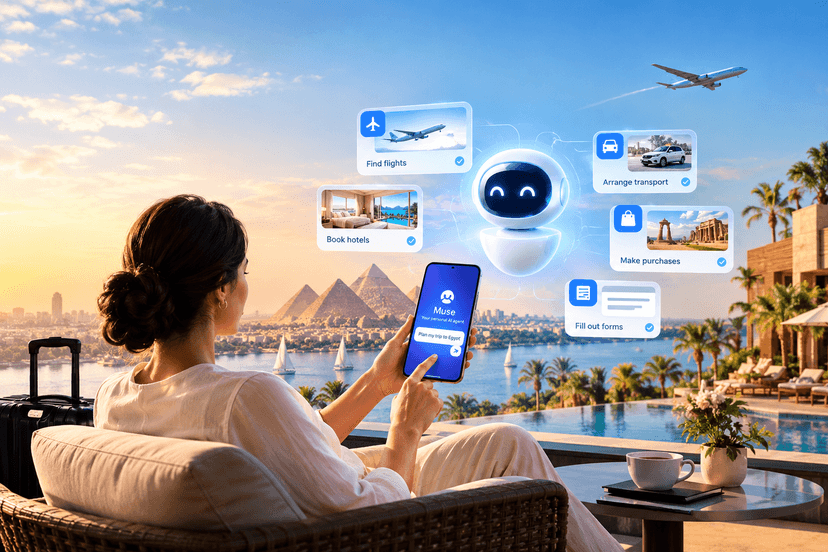
On September 8, 2026, Meta launched Muse, a personal AI agent designed to do more than answer questions. It can work on a user's behalf, browse websites, complete forms, negotiate, book travel and make purchases, subject to the permissions and approvals required for particular actions. Accessible through its own application and WhatsApp, Muse is powered by Meta's Muse Spark model and was initially rolled out in the United States.
What makes this development important for hospitality is not simply that AI can recommend a hotel. Travel websites and chatbots have been doing that for years. The emerging difference is that an AI agent can potentially carry the process further, moving from understanding a traveller's preferences to researching options, making comparisons and completing a booking.
For the hospitality industry, that raises a commercially significant question: if the traveller delegates much of the decision to an AI agent, who influences the final choice—the hotel, the online travel agency, the airline or the AI system deciding which options to present?
The answer could reshape how travel businesses compete for demand.
From travel search to delegated decision-making
The traditional digital travel journey requires the customer to move between websites, compare prices, read reviews, check cancellation policies and complete several booking steps. Each interaction offers a travel company an opportunity to influence the decision, promote its brand or encourage a direct booking.
An agent such as Muse changes the potential distribution of that work. Instead of manually searching across multiple websites, a traveller could ask the agent to plan a trip within a specified budget, compare flights and accommodation, evaluate alternatives and handle the booking process. Meta says Muse can work through a dedicated cloud-based virtual machine with its own browser, continue working after the user closes the application and request approval when sensitive actions, such as sending an email or making a purchase, require it.
This does not mean that AI agents have replaced online travel agencies or that every booking can already be completed autonomously. The more important change is that the interface through which a traveller makes decisions may be shifting. If an agent becomes the customer's primary point of contact, the hotel website may remain essential for delivering inventory and service information, but the traveller may no longer visit it directly.
That creates a new competition for visibility. Hotels have spent years improving website conversion, investing in search engine optimisation, buying digital advertising and building loyalty programmes. In an agent-led environment, those investments may still matter, but hotels may also need to ensure that their rates, availability, room descriptions, policies and other relevant information can be understood and acted upon by AI systems.
The question for hotel leaders is therefore no longer only how to attract a traveller to the booking engine. It is whether the hotel can become a preferred and reliable choice when the traveller delegates that decision to an agent.
The booking process is changing, but the travel industry remains fragmented
The early implementation of Muse illustrates an important limitation. Meta's travel-booking capabilities do not rely on one uniform system. According to travel-industry publication Skift, flight searches can use a direct integration with Duffel, a travel technology company providing access to live airline inventory, while hotel discovery initially relies more heavily on browser-based searches across consumer travel websites.
Why does this distinction matter? Because the quality of an AI agent's decision depends partly on the information it can access and the transactions it can complete. A direct connection to live inventory can provide structured availability and booking options, while browsing websites may require the agent to interpret information displayed across different formats and navigate each provider's own rules.
Hotels face a particular challenge because room rates are not the only variables in a booking decision. The final choice may depend on cancellation terms, breakfast, room configuration, location, loyalty benefits, taxes, payment requirements and availability for specific dates. If an agent cannot reliably compare those details, it may recommend a property that looks attractive on headline price but offers less value once the full conditions are considered.
This is where integrations with hotel technology could become important. On October 20, 2026, hospitality technology provider Cloudbeds announced an integration with Muse intended to make participating hotels' live rates and availability discoverable through the agent, with bookings routed through participating properties' direct booking engines. The rollout is scheduled to begin in the United States in the first quarter of 2027.
The announcement points to a potential direction for hotel distribution: instead of depending entirely on AI agents to browse consumer-facing websites, hotels could provide structured access to live inventory and policies through connected technology platforms. For independent hotels and smaller groups, this could become particularly relevant if direct integration would otherwise require significant technical investment.
However, the Cloudbeds announcement concerns a planned US rollout; it does not establish that the same booking capability is already available to Egyptian hotels. For MENA operators, the immediate task is to understand the emerging model and determine whether their own booking infrastructure will be compatible as agent-led travel expands.
Will AI strengthen direct bookings or create another intermediary?
Hotels have spent years trying to reduce their dependence on third-party distribution and increase direct bookings, where they can retain greater control over the guest relationship and avoid some third-party acquisition costs. AI agents introduce a new variable into that strategy.
If a hotel can make its live rates and availability accessible to an AI agent while preserving its own booking engine, it may have an opportunity to win direct business without requiring the traveller to navigate the hotel's website personally. But if the agent searches primarily through online travel agencies or other intermediaries, the hotel may still depend on those channels to be discovered and booked.
The decisive factor will be how the agent searches, compares and selects its options. Does it prioritise price, location, guest reviews, cancellation flexibility, loyalty benefits or a combination of criteria? Can a hotel explain its distinctive value in a format the agent can interpret? And can a property ensure that its direct offer is competitive without relying on discounts that weaken rate integrity?
These questions matter because AI may change not only where a booking occurs but also who influences the decision before the booking begins. The intermediary that controls the customer interaction could gain leverage over which properties are considered, which options are presented and which booking routes are used. Accenture's September 2026 analysis of AI agents in travel similarly argues that travel brands will need to be understandable, trustworthy and actionable for AI systems, not merely visible to human customers.
For hotels, the implication is that direct distribution strategy will increasingly need to consider both the human guest and the systems acting on that guest's behalf.
A warning from Amazon: access cannot be taken for granted
The transition is unlikely to be frictionless. On September 21, Amazon blocked Muse from shopping on its retail platform, saying the agent's access was unauthorised and that third-party applications should operate transparently and respect a service provider's decision about whether to participate. Meta's launch materials, meanwhile, describe safeguards intended to protect user credentials and require approval for sensitive actions.
Although this dispute concerned retail rather than travel, it illustrates a challenge that hotels, airlines and online travel platforms will also need to consider: an AI agent's technical ability to browse a website does not automatically establish permission to use it for automated transactions. Access rules, privacy, authentication, platform terms and the reliability of bookings will all influence how agent-led commerce develops.
Travel suppliers will therefore need to distinguish between making their information available, authorising an agent to transact and allowing an external system to use their infrastructure at scale. AI agents could generate additional bookings, but they could also generate extensive searches, incomplete transactions or demands on websites and booking engines that do not convert into revenue. The commercial relationship between the agent and the supplier will matter as much as the technology itself.
What should Egypt and MENA do now?
For Egypt and the wider Middle East, the development should be treated as an emerging distribution issue rather than an immediate reason to replace existing sales and marketing systems. The available evidence does not establish how much travel demand in Egypt will soon be booked through Muse or similar agents, and Muse's initial rollout was in the United States. Nevertheless, regional hotels, destination organisations and travel companies can begin reviewing the readiness of their digital infrastructure.
Hotels should first ensure that their core product information is accurate and consistent across their websites, booking engines and distribution partners. Room descriptions, live rates, taxes, cancellation policies, meal plans, availability and location information should be easy for digital systems to interpret. Revenue managers and commercial directors should also monitor how agent-driven searches may change price comparison, booking lead times and direct-versus-indirect channel production.
Hotel technology providers and distribution partners have a role to play as well. The expansion of structured connections between AI agents and booking systems could determine which properties are discoverable through agent-led planning and whether a reservation can be completed without sending the customer through multiple disconnected interfaces. In markets where many independent properties operate with limited digital resources, accessible integration solutions could matter more than adopting a sophisticated AI tool in isolation.
Destination marketing organisations will need to think about the same issue at a larger scale. If travellers increasingly ask AI agents to recommend a destination based on budget, travel dates, climate, interests and practical access, then accurate, current and machine-readable information about attractions, transport, hotels and experiences becomes part of destination competitiveness. A destination needs to be not only attractive to people but also reliably represented in the information systems helping those people make decisions.
The next competition may be for the AI agent's recommendation
Muse is an early example of a broader change in digital commerce: users may increasingly delegate research, comparison and transactions to agents rather than complete every step themselves. That shift is not yet universal, and its consequences for hospitality will depend on adoption, supplier integrations, consumer trust and the commercial rules governing access to travel inventory.
But the direction is important. Hotels and destinations that treat AI only as a content-generation tool may miss its potential effect on distribution. The bigger strategic question is how their products will be discovered, evaluated and purchased when software begins to make more of the decisions that travellers once made themselves.
Tourism Club View
Meta's Muse launch brings an important question into sharper focus for hospitality leaders: when the customer delegates the journey to AI, does the hotel still control how it competes for that customer?
The answer will depend on whether hotels and tourism businesses can make their products visible, their information reliable and their booking systems accessible to emerging AI agents, while protecting pricing discipline, data security and the direct guest relationship.
For Egypt and MENA, the immediate priority is not to assume that agentic travel will replace existing distribution channels overnight. It is to prepare for a market in which the traditional traveller, the online travel agency and the AI agent may all play different roles in the same booking journey.
The hotels that adapt will not necessarily be those using the most AI. They will be the ones that understand where the booking decision is being made, how their product is being evaluated and how to remain commercially competitive when the first customer to compare their rooms may be a machine acting for a human.
Sources
Meta — Introducing Muse: The World’s First Personal AI Agent Built for Everyone
PhocusWire — Meta launches AI agent with travel booking capabilities
Skift — Meta Says Its Muse Agent Books Travel. Here’s What That Means
Hospitality Net — Cloudbeds announces integration with Meta’s Muse