AI Is Rewriting the Tourism Journey in the Middle East — But Who Will Control the Traveller?
Industry Insights | 13 September 2026
From automation inside hotels to a potential reshaping of the traveller journey, artificial intelligence is entering a new phase across the Middle East. The strategic question is no longer simply how tourism businesses use AI, but where tourism decisions will be made and who will control the relationship with the traveller.
In tourism, competition usually begins long before the traveller reaches the hotel.
It starts from the moment they think about their destination, then search, compare, select their flight, hotel and experience. For decades, this journey has passed through a clear group of intermediaries: search engines, travel agencies, hotel websites, airlines and booking platforms.
But artificial intelligence opens a different possibility.
Instead of searching through dozens of websites themselves, travellers can begin with a single question: Where should I go? Which hotel is right for me? How much will the trip cost? And what is the best programme I can follow over five days?
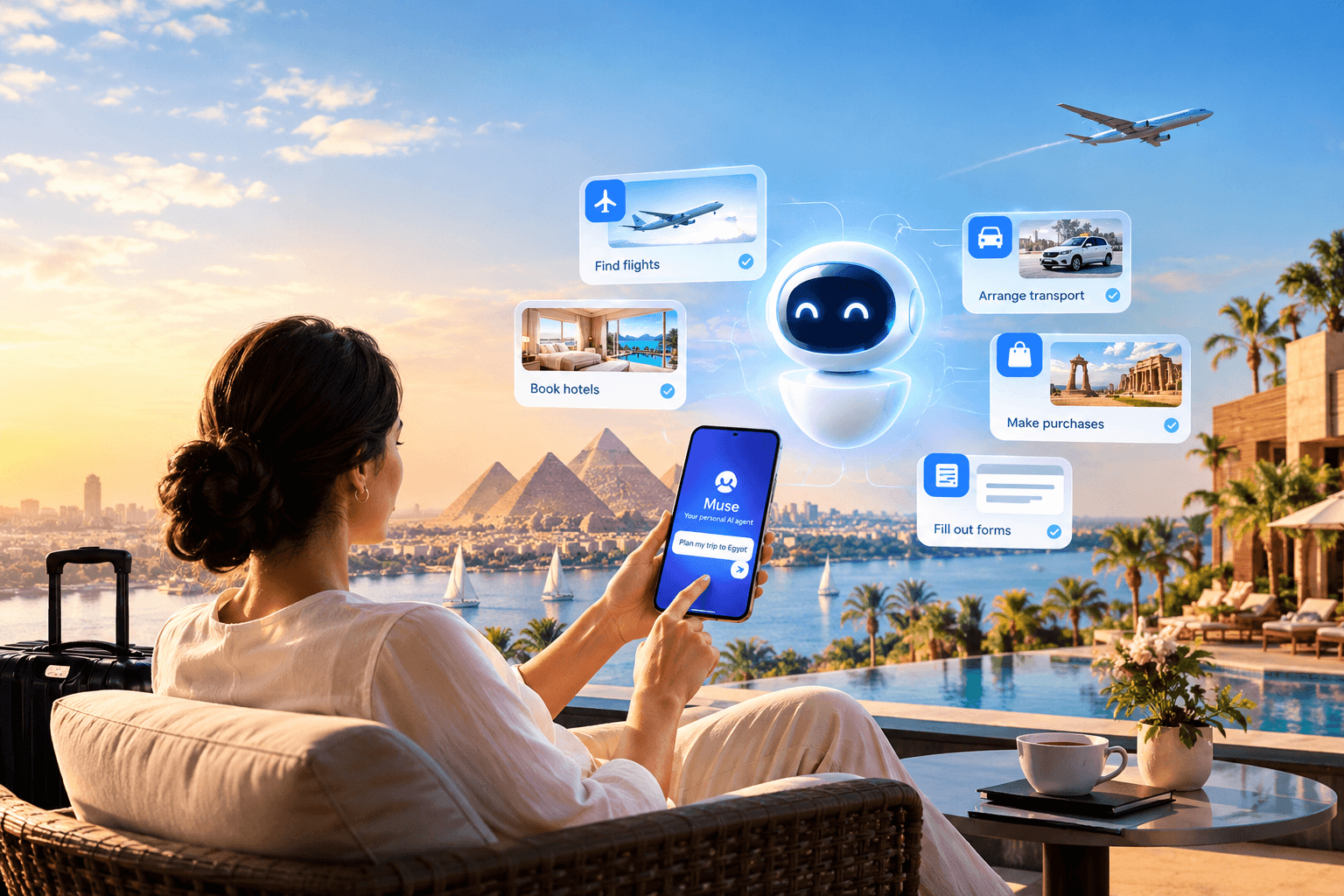
At this point, artificial intelligence is no longer simply a tool inside a tourism company. It can become the decision interface itself.
And this is the point that deserves the attention of the Middle East tourism industry in 2026.
Tourism Enters a New AI Phase
The regional evidence indicates that the Middle East has moved beyond the theoretical discussion of artificial intelligence.
According to Deloitte's 2026 study, 66% of organizations in the Middle East said they had achieved improvements in efficiency as a result of using artificial intelligence, but only 34% use it to fundamentally redesign products, processes or business models. In addition, 84% of regional organizations have not yet redesigned jobs or ways of working around AI capabilities.
The picture is even clearer in the Gulf Cooperation Council markets.
A McKinsey study published in November 2025 found that 84% of organizations surveyed use artificial intelligence in at least one function, but only 31% have reached the stage of institutional scaling or full implementation, while only 11% of organizations were classified as having achieved tangible value from AI according to the study's definition.
There is therefore a fundamental difference between two questions:
Does the organization use artificial intelligence?
and
Has the organization redesigned the way it works because of artificial intelligence?
The first is becoming common.
The second is still at an early stage.
This gap is particularly important for tourism because the real value of AI may not come from using a new tool inside the hotel, but from redesigning the entire tourism value chain.
From Efficiency to Transformation
There is another question that tourism leaders must ask:
If artificial intelligence becomes available to every hotel, does artificial intelligence itself remain a competitive advantage?
Perhaps not.
If every hotel can use AI to forecast demand, optimize prices, manage campaigns, respond to customers, analyze reviews and schedule employees, using the same tool will not be enough to create competitive superiority.
The advantage may move elsewhere:
Data quality.
Then:
Management's ability to interpret it.
Then:
Decision-making speed.
Then:
The organization's ability to integrate technology into operations.
Then:
Trust, brand and service quality.
This is consistent with a broader regional challenge; Roland Berger's 2026 study found that four out of five Gulf organizations have an AI strategy, but only 34% have an appropriate institutional data foundation that enables them to scale.
The problem, therefore, is not always the absence of artificial intelligence.
It may be the absence of the environment that makes artificial intelligence useful.
The Tourism Journey Is Changing
The larger transformation may not happen inside the hotel.
It may happen before the guest reaches the hotel.
The tourism journey can be divided into a connected sequence:
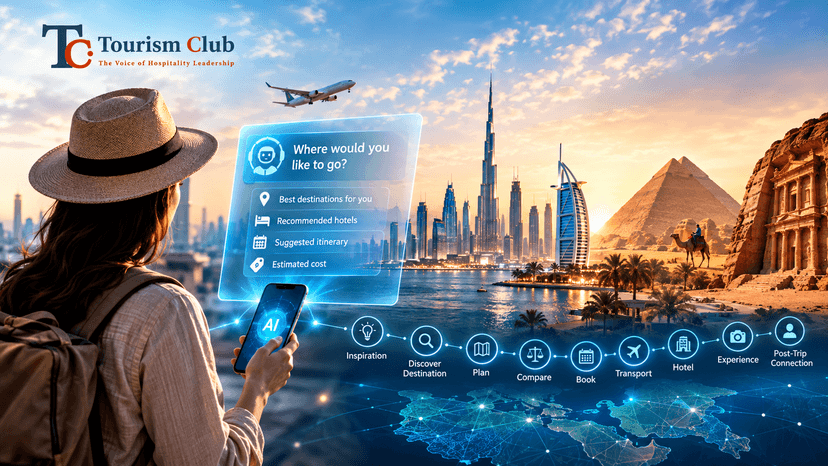
Inspiration → Destination discovery → Planning → Comparison → Booking → Transportation → Hotel → Experience → Post-trip relationship.
Until now, different parties have owned different parts of this journey.
The hotel owns the relationship during the stay.
The airline owns an important part of the transportation journey.
The booking platform owns an important part of comparison and booking.
The destination attempts to influence the decision to visit.
The search engine influences discovery.
An artificial intelligence interface capable of understanding a traveller's needs and connecting them with a set of options could bring these stages together at a single point.
Here a more important question emerges than simple "customer personalization":
What happens if the traveller no longer searches for a hotel, but artificial intelligence chooses the hotel for them?
This is not yet an established fact, and it should not be treated as one.
Expedia Group's research published in April 2026 indicates that travellers are increasingly using artificial intelligence to plan and discover trips, but around 70% still prefer to complete bookings with trusted travel brands rather than AI bots or agents. This reveals an important gap between using AI for discovery and trusting it to complete the transaction. The transition, therefore, is not complete. But its direction deserves attention.
A New Question for the Tourism Industry: Who Controls the Traveller?
The traditional travel model can be simplified as:
Search → Compare → Book.
The potential AI-supported model is:
Ask → Receive a recommendation → Decide → Book.
The difference may appear small, but economically it is significant.
In the first model, the traveller sees dozens of options and decides for themselves.
In the second, they may receive only three options, or even one option that the system considers the most suitable.
The recommendation process itself therefore becomes a commercial asset.
Who appears in the recommendation?
Why do they appear?
What data led to that appearance?
And who pays for access to that customer?
These questions may become more important than a hotel's ranking in traditional search results.
This is where the distribution of power within tourism may begin to change.
Who Owns the Customer?
If artificial intelligence becomes a primary interface for travel decision-making, some power may gradually move from traditional websites and platforms toward systems that control the recommendation process. This does not necessarily mean that hotels, airlines or booking platforms will disappear. It may instead mean that the customer relationship becomes more complicated. A hotel may own guest data, but it may not own the moment when the decision to select that hotel was made. A destination may spend millions of dollars on marketing, but it may face a future in which appearing inside an intelligent recommendation system is more important than appearing in a traditional advertisement. This leads to the strategic question:
If artificial intelligence makes the recommendation, who owns the relationship with the customer: the hotel, the platform, or the system that made the recommendation?
There is no final answer yet. But this issue could become one of the most important commercial battles in the travel industry in the coming years.
The Middle East Has Different Conditions
The region is not a single tourism market. But some of its countries possess a combination of factors that make it an important environment for AI-enabled tourism: major investments in digital infrastructure, rapid tourism expansion, new destination projects, advanced infrastructure in some markets, and increasing integration between technology and economic policy. GSMA's 2025 research indicates that organizations in the Middle East were advancing in the adoption of advanced digital technologies, including artificial intelligence, cloud computing and 5G, compared with a number of global markets, driven by national digital agendas and accelerating investment. But this does not mean the region has reached full transformation. On the contrary, McKinsey and Deloitte evidence indicates that the central challenge is no longer access to AI tools, but turning them into scalable institutional capabilities. This makes Saudi Arabia and the United Arab Emirates important cases to examine.
Saudi Arabia: AI Within a Larger Tourism Transformation
Saudi Arabia does not treat tourism as a sector separate from economic transformation.
According to Saudi Ministry of Tourism annual statistics, the Kingdom recorded around 123 million tourists from domestic and inbound tourism in 2025, with tourism expenditure reaching approximately SAR 304 billion, while tourism's direct contribution to GDP reached 4.9% in 2024.
The OECD's 2026 report also indicates that Saudi Arabia recorded 122.6 million overnight visitors in 2025, exceeding its target of 100 million for the third time, while raising its ambition to 150 million tourists by 2030.
These figures change the question.
The question is not simply: how can Saudi Arabia use artificial intelligence in hotels?
It is:
How can artificial intelligence be used to manage a tourism economy expanding at this scale?
In June 2026, Saudi Arabia's Ministry of Tourism announced the launch of the "Tourism AI Vision", aimed at using artificial intelligence across the visitor journey, increasing productivity, empowering investors and professionals, and improving the quality of the tourism experience.
Saudi tourism digital transformation initiatives also indicate a move toward a more integrated ecosystem based on smart infrastructure, data, analytics and digital technologies to manage the tourism experience.
This matters because Saudi Arabia is not only building new hotels.
It is building new destinations, expanding demand, developing infrastructure and attempting to attract different markets.
In this context, artificial intelligence can become a tool for coordinating an entire tourism ecosystem rather than simply a tool for hotel guest services.
United Arab Emirates: Building an Integrated Digital Tourism Environment
The United Arab Emirates, particularly Dubai, offers a different model.
Dubai received 19.59 million international visitors in 2025, an increase of 5% over 2024, marking the third consecutive record-breaking year.
At the same time, the emirate is developing artificial intelligence and digital infrastructure at the city level, not only within tourism.
In 2025, Dubai announced initiatives including an AI infrastructure enablement platform and a team to accelerate its use, as part of a broader direction toward transforming the city into a more intelligent and technology-driven environment.
Within tourism, Dubai's Department of Economy and Tourism entered a partnership with Amadeus to develop travel technology solutions, including travel data analysis, marketing, improvements to the traveller journey, support for startups and the development of tourism intelligence for hospitality and destinations.
In December 2025, Dubai also announced the introduction of a digital and contactless hotel check-in system at city level, allowing visitors to complete check-in procedures in advance and use digital verification when arriving at hotels.
The difference here is that technology is not entering tourism through one door.
It is entering through the city, the airport, the hotel, data, marketing and the destination at the same time.
This may give Dubai a different advantage from simply having the best hotel application.
Egypt: The Challenge Is Building Capability at Scale
Egypt enters this phase from a different position. It has a major advantage in destination scale and product diversity, but at the same time faces the challenge of turning this scale into an integrated digital ecosystem. Egypt received approximately 19 million international tourists in 2025, an increase of 21% compared with 2024, representing very strong growth and placing the sector in a new phase of expansion. In January 2025, Egypt launched the second edition of its National Artificial Intelligence Strategy for the 2025–2030 period, with a focus on infrastructure, skills development, data governance, innovation and entrepreneurship.
In March 2026, the implementation plan for the strategy was announced, with sub-indicators for monitoring implementation, alongside activation of the open data policy.
In tourism, the Ministries of Tourism and Antiquities and Communications and Information Technology signed cooperation protocols in October 2025 to support digital transformation and develop smart infrastructure for archaeological sites and museums, including the "Digital Egypt Heritage Portal" project. But for Egypt, the issue is not simply buying new AI tools. The larger challenge is building the capabilities that allow these tools to operate on good data, connected systems, appropriate skills and institutions capable of using information for decision-making. This particular point may become decisive in the competition.
Data Becomes a Strategic Tourism Asset
Tourism is naturally fragmented.
A hotel has guest data.
An airline has flight data.
A destination has visitor data.
A tourism company has demand data.
A booking platform has search and booking data.
If these data remain separated, each organization sees only part of the picture.
If data become more integrated, it may become possible to understand the tourism journey more accurately.
This creates a strategic equation:
Data → Intelligence → Decision → Customer relationship → Value → Competitive power.
But this equation works only when the data are reliable, integrated and properly governed.
For this reason, competition in tourism may not be only between hotels or destinations.
It may also become competition between data ecosystems.
The Changing Role of Tourism Professionals
The discussion about artificial intelligence and tourism should not stop at the question: how many jobs could disappear?
The more useful question is:
Which skills become more valuable when machines take over part of routine cognitive work?
In a tourism environment increasingly dependent on artificial intelligence, the value of human judgment, leadership, negotiation, relationship-building, cultural understanding, problem-solving and creativity may increase.
The hotel manager of the future may not be required to manually analyze every piece of data.
But they will be required to know:
Is the data correct?
Is the recommendation logical?
Does the decision serve the brand?
Is the proposed price appropriate for the market?
And when should the system's recommendation be ignored?
This is not purely a technical skill.
It is a new management capability.
The Real Challenge: Organizational Capability
Here we reach one of the most important conclusions emerging from the regional evidence.
The Middle East does not necessarily suffer from a lack of access to artificial intelligence technologies.
Recent studies repeatedly point to other challenges: data, skills, technical infrastructure, governance and integration.
This means the next competition may be between two organizations that possess exactly the same AI tools.
The first uses artificial intelligence on fragmented systems, poor data and old processes.
The second redesigns its way of working around data, decision-making and speed.
The first uses artificial intelligence.
The second rebuilds the organization using artificial intelligence.
The difference between the two may become greater than the difference between a company that uses AI and one that does not.
What Comes Next for Tourism in the Middle East?
Over the coming period, there are five indicators worth monitoring more closely than the number of chatbots being used by hotels:
First: Where does the traveller begin the journey?
Does the journey begin with a search engine, booking platform, social network or artificial intelligence system?
Second: Who provides the recommendation?
Does the hotel reach the customer, or does the customer reach the hotel following a recommendation from an intelligent system?
Third: Who owns the data?
And who can connect it and turn it into decisions?
Fourth: Where does the booking take place?
Does artificial intelligence remain a planning tool, or does it move into completing the transaction?
Fifth: Who owns the relationship after booking?
Because tourism value does not end with the sale. The experience itself generates data, relationships, repeat-visit opportunities and additional sales opportunities.
Tourism After AI May Not Be the Same Tourism
The biggest transformation may not be that the hotel has become more efficient.
Nor that the traveller receives faster answers.
Nor that a receptionist has started using an intelligent tool.
The deeper change may occur if the point of decision-making itself moves.
From:
Traveller searches → sees options → compares → decides.
To:
Traveller explains the need → system understands → system narrows the market → system recommends → traveller decides.
If this model expands, the value of market visibility may change.
The question will not only be:
Does the traveller know your brand?
But:
Does artificial intelligence know your brand when the traveller asks for the best option?
At this point, artificial intelligence becomes more than technology.
It becomes a new layer between tourism demand and tourism supply.
TOURISM CLUB VIEW
The current evidence does not allow us to say that artificial intelligence will replace search engines, booking platforms or travel agencies in the near future. The evidence available in 2026 indicates that adoption is advancing rapidly, but trust, booking and institutional implementation remain distributed between old and new models.
But the strategic direction is clearer:
Artificial intelligence is moving from inside the organization to the interface between the organization and the customer.
The real winner in Middle Eastern tourism will therefore not necessarily be the hotel with the best AI tool.
Nor will it necessarily be the destination that spends the most on technology.
It will be the organization that can transform:
Data into knowledge,
knowledge into decisions,
decisions into experiences,
experiences into trust,
and trust into a direct relationship with the traveller.
If artificial intelligence becomes part of the travel decision-making process, competition will not be only about who owns the room, seat or journey. It will be about who owns the moment when the traveller makes the decision. And that may be one of the most important stories in tourism's transformation over the coming years.