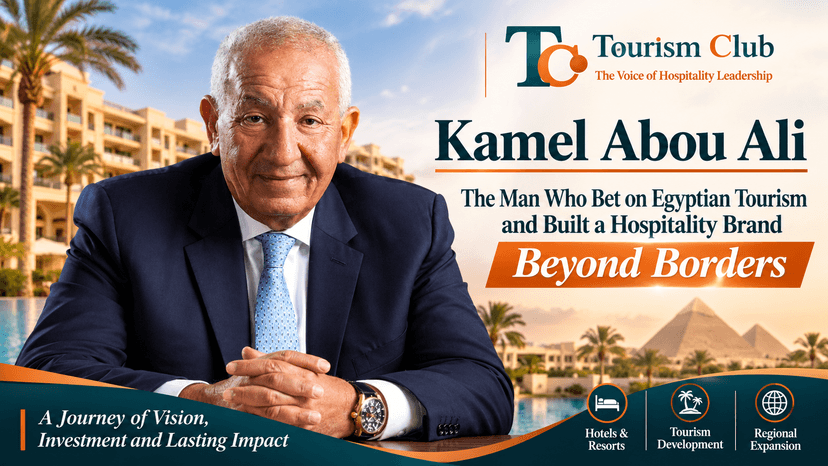
From Port Said to Switzerland, and from Hurghada to Morocco: The story of an investor who saw a hotel not merely as a building, but as an economic venture and an integrated tourism experience.
In the tourism industry, there is a distinction between an entrepreneur who invests in hotels and one who builds a brand capable of expanding and sustaining its presence across different markets.
The journey of Egyptian businessman Kamel Abou Ali deserves to be explored from this perspective. His story is not simply about the number of hotels and resorts he owns; it is about an investment journey spanning decades, beginning with an experience abroad before returning to establish a distinctive presence in one of Egypt's most important economic sectors.
The Beginning: From Port Said to Switzerland
Kamel Abou Ali was born in Port Said in 1954. His early life was shaped by difficult circumstances, including the displacement of his family during the period of war.
In 1974, he travelled to Switzerland, where he spent approximately 15 years working and developing his business experience and professional relationships.
According to the biography published on the official Pickalbatros Group website, his European experience played an important role in shaping his investment vision before he returned to Egypt in 1992 with the ambition of establishing his own hotel brand.
His return marked a significant turning point. Rather than continuing to build his business outside Egypt, he chose to bring his experience to a tourism market rich in natural assets and promising opportunities, particularly along the Red Sea coast.
1992: The Beginning of Pickalbatros
In 1992, Kamel Abou Ali launched his first project, Beach Albatros Resort in Hurghada, marking the starting point of Pickalbatros Hotels & Resorts.
This was not simply the opening of another hotel establishment; it was the beginning of building an investment entity specialising in hotels and tourism resorts.
Over the years, the group's operations expanded across various Egyptian destinations, including Hurghada and Sharm El Sheikh, before extending beyond Egypt into Morocco.
This is where one of the most significant aspects of the journey becomes evident: expansion was not limited to increasing the number of properties. It was also associated with developing different hospitality, leisure, and accommodation concepts.
From Hotel Investment to Creating a Tourism Experience
An analysis of the Pickalbatros business model reveals an emphasis on integrating multiple elements into the overall tourism product.
A hotel is no longer simply a room, a restaurant, and a collection of facilities. It has evolved into an integrated experience encompassing:
Accommodation: Hotel stays and accommodation services.
Food & Beverage: Dining and culinary experiences.
Entertainment: Entertainment activities and programmes.
Sports & Leisure: Sports and recreational activities.
Family Experience: Family-oriented hospitality experiences.
Guest Experience: The guest's experience throughout every stage of their stay.
This diversity reflects an important understanding of the competitive nature of the hospitality industry: guests do not simply purchase a room. They choose a destination, an experience, and memories.
Through its various hospitality concepts, the group targets multiple customer segments, ranging from families to travellers seeking accommodation experiences designed specifically for adults.
Beyond Borders: The Moroccan Experience
The ambition did not stop at the Egyptian market.
Pickalbatros Group entered the Moroccan market and expanded its presence in tourism destinations such as Marrakech and Agadir through a variety of hospitality and entertainment properties and projects.
This expansion carries an important strategic implication: transferring investment and operational expertise into a different market while adapting to the requirements of new customers and tourism destinations.
From a Business Strategy perspective, this type of expansion represents Geographic Diversification: extending business operations across different geographical markets, creating new growth opportunities while reducing dependence on a single market.
The Group's Scale and Position in the Tourism Industry
According to Forbes Middle East's Top 100 Travel & Tourism Leaders 2026, Kamel Abou Ali ranked 34th as Founder and Chairman of Pickalbatros Hotels & Resorts.
Forbes reported that the group operated 45 properties across Egypt and Morocco, with more than 20,000 rooms as of September 2026.
This scale reflects the transformation of an individual hotel investment into a group with a significant regional presence.
What Can the Hospitality Industry Learn from This Experience?
Beyond the figures, several important managerial and investment lessons can be drawn from this experience:
1. Long-Term Vision
Building a large hospitality business requires a long-term vision rather than focusing solely on generating quick returns from a single project.
2. Brand Development
A strong brand provides investors with greater opportunities to expand and deliver a consistent experience across different destinations.
3. Product Differentiation
Diversifying hotel concepts and services helps businesses reach different market segments.
4. Geographic Expansion
Expanding into new markets requires an understanding of differences between destinations, tourism demand, and investment environments.
5. Human Capital
Operating a hospitality group of this scale requires capable teams, effective operating systems, and specialised management expertise.
The Bigger Question: How Can Individual Success Stories Become an Economic Force for Egyptian Tourism?
Kamel Abou Ali's story opens a discussion that extends beyond the experience of a single businessman.
Egypt possesses diverse tourism assets, a distinctive geographical location, and destinations capable of attracting different categories of travellers.
However, transforming these advantages into sustainable economic value requires more than building hotels. It requires long-term investment, human capital development, improved service quality, and stronger competitiveness across Egyptian destinations.
This is where the question facing the industry becomes particularly relevant:
Can Egypt build more homegrown hotel brands capable of competing and expanding regionally and globally, or will our success continue to be measured primarily by the number of hotels and available rooms?
TOURISM CLUB
The Story Behind the Industry
Prominent Hospitality Figures | Business Stories | Hospitality Insights